If you’re thinking, “How do I get beautiful skin?”, you probably won’t achieve it by buying a thousand different creams and fancy products. A healthy complexion usually comes down to protecting it from the sun, keeping it moisturized, cleansing regularly, choosing products that suit your skin type, and being patient enough to see results.
Your complexion doesn’t have to be perfect to be beautiful. It can have blemishes, pimples, scars, visible pores, wrinkles, or freckles and still look healthy and attractive.
A proper skincare routine should leave your complexion feeling comfortable and soft while looking healthy, radiant, and balanced—not tight, itchy, burning, or stripped.
If you struggle with excess shine, these How to Do Makeup for Oily Skin: 15 Shine-Reducing Tips can help you create a smoother, longer-lasting makeup look.

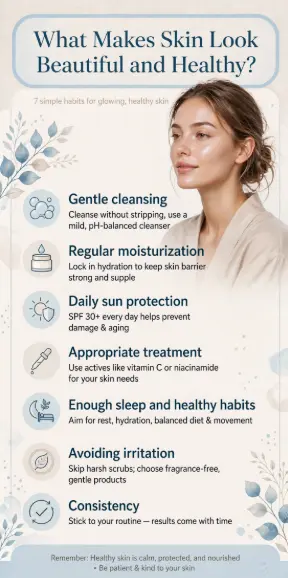
What Makes Skin Look Beautiful and Healthy?
Skin tends to look its best when it is well cared for and its barrier is not constantly being irritated.
That means focusing on a few fundamentals:
- Gentle cleansing
- Regular moisturization
- Daily sun protection
- Appropriate treatment for specific concerns
- Enough sleep and generally healthy habits
- Avoiding unnecessary irritation
- Consistency
The American Academy of Dermatology recommends choosing skincare products according to your skin’s needs rather than assuming that one routine works for everyone.
You also don’t need to chase every viral skincare trend. A complicated routine isn’t automatically a better routine.
1. Keep Your Skincare Routine Simple
If you’re starting from scratch, begin with three basic products:
- Gentle cleanser
- Moisturizer
- Broad-spectrum sunscreen with SPF 30 or higher
That’s enough to have a good foundation.
Then, if you tolerate your cream and serums well, you can begin using a product to target a specific concern, such as acne or wrinkles.
If you’re wondering how do I make my skin beautiful, start with a simple skincare routine you can actually stick with instead of an extensive routine you’re unlikely to maintain.
Adding five products at once can be overwhelming; you wouldn’t know which one was helping or causing irritation.
If you’re new to makeup, check out Beginner Makeup Kit on a Budget: What You Actually Need for a simple list of affordable essentials to get started.

2. Cleanse Without Stripping Your Skin
Clean skin doesn’t have to feel tight.
A good cleanser should remove excess oil, sweat, makeup, sunscreen, and daily buildup without stripping away the natural oils that help keep your complexion comfortable.
If your face consistently feels tight or itchy right after cleansing, your cleanser may be too harsh.
For Dry or Sensitive Skin
Look for a gentle, fragrance-free cleanser and avoid aggressive scrubbing.
For oily skin
A gentle foaming cleanser can help remove excess oil. However, trying to completely strip away oil can cause irritation.
The AAD recommends gentle cleansing for oily skin rather than harsh face washes that leave your complexion feeling extremely dry.
For a smoother makeup look, explore Makeup That Doesn’t Settle Into Fine Lines: Tips for Mature Skin for practical techniques and product tips.

One simple rule
Clean your skin; don’t punish it.
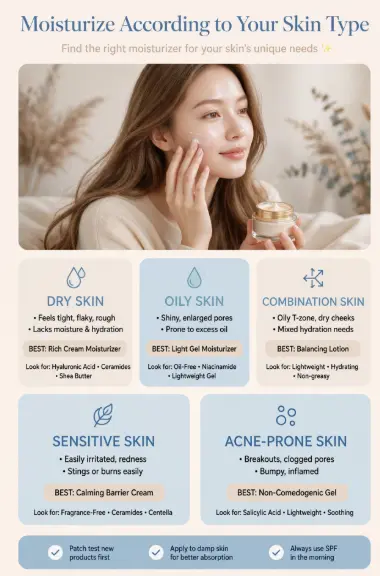
3. Moisturize According to Your Skin Type
Moisturizer isn’t only for people with dry skin.
Even oily or acne-prone skin can benefit from appropriate hydration. If you are prone to breakouts, look for products labeled oil-free or non-comedogenic.
Different textures can also work better for different needs:
| Skin type | Moisturizer approach |
|---|---|
| Dry | Cream or richer moisturizer |
| Oily | Lightweight lotion or gel |
| Combination | Lightweight product, with extra moisturizer on dry areas |
| Sensitive | Simple, fragrance-free formula |
| Acne-prone | Non-comedogenic moisturizer |
For very dry complexions, apply moisturizer while your face is still slightly damp to help lock in moisture. The AAD recommends this approach for dryness.
Look for useful moisturizing ingredients such as ceramides or hyaluronic acid when they suit your needs.
4. Wear Sunscreen Every Day
If you only add one anti-aging or skin-protection habit to your routine, make it sun protection.
Choose a sunscreen labeled:
- Broad spectrum
- SPF 30 or higher
- Water resistant
These are the three characteristics the American Academy of Dermatology recommends looking for when choosing sunscreen.
Sun protection doesn’t just prevent sunburns. UV exposure can lead to premature skin aging and is a contributing factor to wrinkles, dark spots, and skin cancer.
Don’t forget areas that are often overlooked, including your:
- Neck
- Ears
- Chest
- Hands
When you’re spending extended time outdoors, sunscreen needs to be reapplied according to the product directions and your exposure.
And sunscreen works best as part of a larger strategy that includes shade, protective clothing, and avoiding intentional tanning.

5. Add One Targeted Ingredient at a Time
Once you’ve established your basic routine, you may want to address a particular concern.
The important word is particular.
Don’t choose ingredients simply because they are trending.
For uneven or dull-looking skin
Vitamin C is commonly used in skincare routines focused on antioxidant protection and brighter-looking skin.
For acne and clogged pores
Salicylic acid can be useful for some people with oily or acne-prone skin, although stronger or more frequent use can cause irritation.
For signs of aging
Retinoids are among the better-established topical ingredients used for concerns related to skin aging. However, they aren’t appropriate for everyone, and irritation is possible.
For hydration
Such ingredients as hyaluronic acid may help to achieve a hydrated effect.
The most suitable component depends on the desired result.
Instead of buying a particular serum, believing in miracles, it is necessary to understand what problem is to be solved and select the suitable ingredient to make progress.

6. Stop Over-Exfoliating
One of the simplest mistakes you can make when trying to improve your appearance is assuming that more exfoliation will automatically lead to a healthier-looking complexion.
It doesn’t.
Using multiple exfoliants, acids, scrubs, peels, or harsh treatments too often can cause irritation, leaving your complexion dry, red, and uncomfortable.
This is especially important if you have a sensitive or dry complexion. The AAD cautions against excessive stripping and exfoliation, which can worsen dryness and irritation.
If you start experiencing burning, stinging, or noticeable irritation after introducing a new product, don’t add another product to fix the problem. Instead, consider simplifying your routine and giving your complexion time to recover.
Sometimes, less really is more.

7. Support Your Skin With Healthy Habits
Skincare products are only one part of the picture.
Your everyday habits matter too.
Prioritize sleep
Poor sleep can leave you looking tired even when your skincare routine is excellent.
Eat a balanced diet
Instead of searching for one “beauty food,” focus on an overall eating pattern that includes a variety of nutrient-rich foods.
Stay reasonably hydrated
Water is important for overall health, but drinking excessive amounts won’t magically transform your complexion. Think of hydration as one part of a healthy lifestyle—not a miracle skincare treatment.
Don’t smoke
Smoking accelerates visible signs of aging and can interfere with wound healing. The AAD includes avoiding smoking among its recommendations for maintaining a healthier appearance.
Protect your skin from unnecessary sun exposure
This remains one of the highest-value habits for maintaining the appearance and health of your skin.

8. Match Your Routine to Your Skin Type
There isn’t one perfect skincare routine.
Dry skin
Prioritize:
- Gentle cleansing
- Richer moisturizer
- Fragrance-free products if you’re sensitive
- Regular sun protection
- Minimal harsh exfoliation
Creams and ointments are generally more moisturizing than lightweight lotions, according to AAD guidance.
Oily skin
Focus on:
- Gentle cleansing
- Lightweight moisturizer
- Non-comedogenic products
- Appropriate acne treatments if needed
- Daily sunscreen
Don’t try to eliminate every trace of oil.
Combination skin
Treat different areas according to their needs.
Your cheeks may need more moisture while your forehead and nose may become oily.
Sensitive skin
Keep things simple.
Choose gentle, fragrance-free products and introduce new products cautiously. If a product causes persistent burning, redness, or irritation, stop using it.
Acne-prone skin
Dermatologists recommend not drying out the skin.
Using a gentle cleanser, a good moisturizer, sunscreen, and an effective acne treatment are other excellent ideas.
If your skin is breaking out badly, or it’s pitted or pitted and hard to treat, you should see a dermatologist about more aggressive treatments.
9. Give Your Routine Time to Work
Skincare isn’t usually an overnight transformation.
One of the biggest problems with social-media skincare is that people see someone’s dramatic result and assume they need the same products immediately.
Real life is different.
Your skin has its own:
- Genetics
- Oil production
- Sensitivity
- Hormonal influences
- Age-related changes
- Environmental exposures
- Existing skin conditions
One of the simplest mistakes you can make when trying to improve your appearance is assuming that more exfoliation will automatically lead to healthier-looking skin.
It doesn’t.
Using multiple exfoliants, acids, scrubs, peels, or harsh treatments too often can cause irritation, leaving your skin dry, red, and uncomfortable.
This is especially important if you have sensitive or dry skin. The AAD cautions against excessive stripping and exfoliation, which can worsen dryness and irritation.
If your skin starts burning, stinging, or becoming noticeably irritated after introducing a new product, don’t add another product to fix the problem. Instead, consider simplifying your routine and giving your skin time to recover.
Sometimes, less really is more.

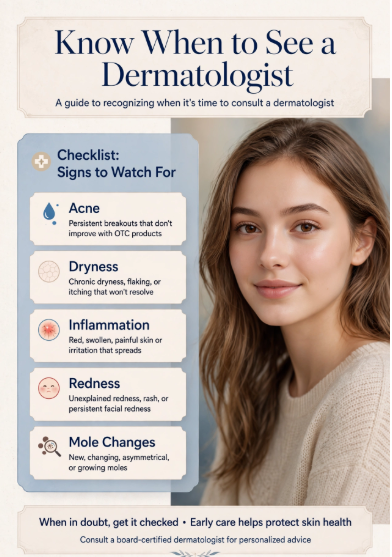
10. Know When to See a Dermatologist
Skincare is not always a cosmetic problem.
See a dermatologist if you have persistent or worsening:
- Acne
- Severe dryness
- Painful inflammation
- Persistent redness
- Unexplained rash
- Significant pigmentation changes
- Scarring
- A mole or spot that changes, itches, or bleeds
The AAD recommends having concerning skin changes evaluated rather than trying to manage everything with cosmetic products.
Professional advice can also save money: instead of buying ten products for an undiagnosed problem, you can find out what you’re actually treating.
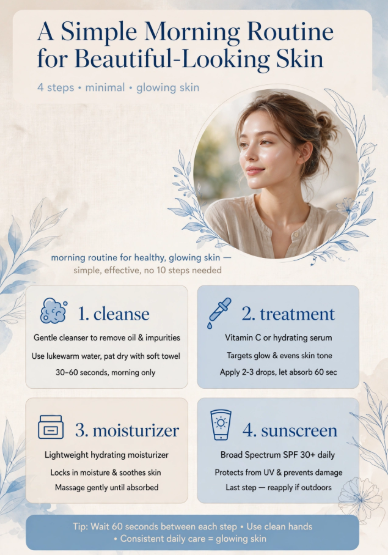
A Simple Morning Routine for Beautiful-Looking Skin
You don’t need a 10-step routine.
Try this order:
1. Gentle cleanse or rinse
Use whichever approach leaves your skin comfortable.
2. Optional treatment
For example, a product chosen for a specific concern.
3. Moisturizer
Choose a texture that works for your skin.
4. Sunscreen
Finish with broad-spectrum SPF 30+.
If your sunscreen is moisturizing enough for you, you may not need a separate morning moisturizer.
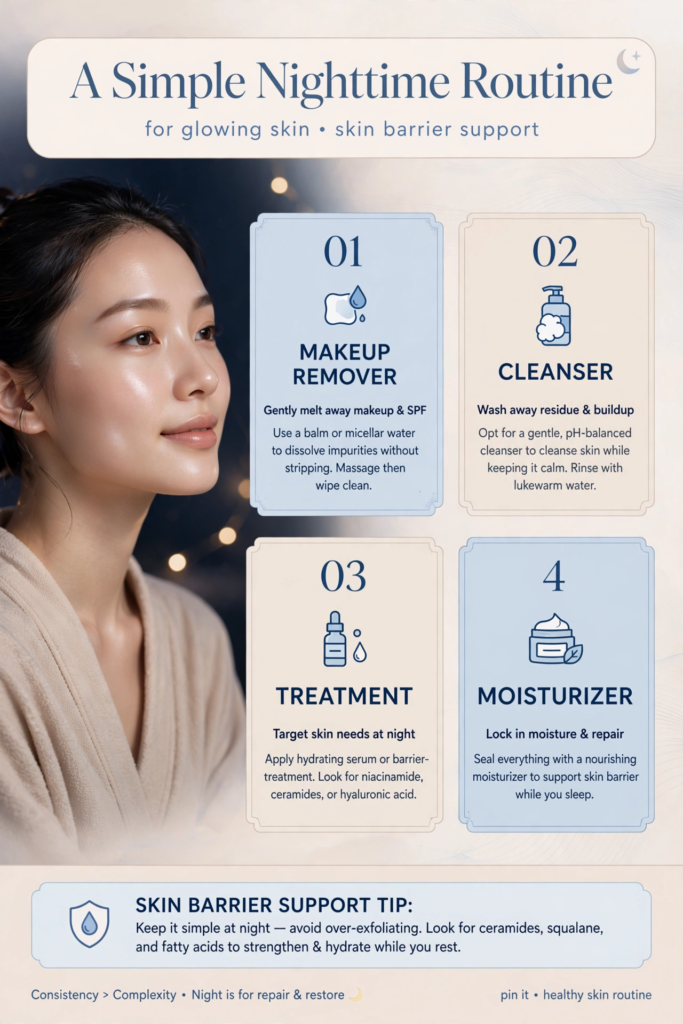
A Simple Nighttime Routine
At night, focus on removing the day’s buildup and supporting your skin barrier.
1. Remove makeup and sunscreen
If necessary, use a suitable makeup remover or cleansing step first.
2. Gentle cleanser
Wash without aggressive scrubbing.
3. One targeted treatment
Only if you need one.
4. Moisturizer
Keep the final step simple and comfortable.
If your skin becomes irritated, temporarily return to the basics rather than continuing to layer active ingredients.
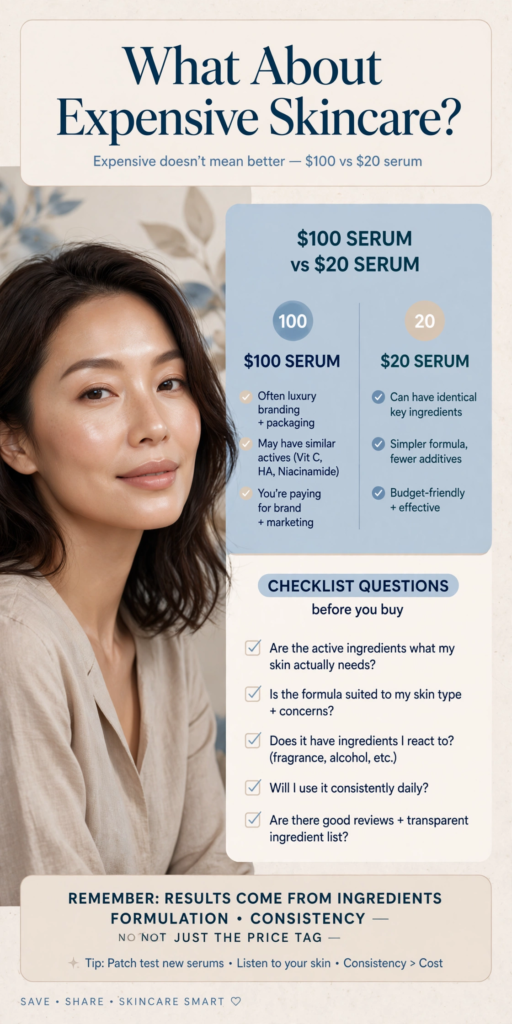
What About Expensive Skincare?
Expensive doesn’t automatically mean better.
A $100 serum isn’t necessarily more appropriate for your skin than a $20 product.
Before buying something expensive, consider:
- Is the ingredient appropriate for my concern?
- Will my skin tolerate it?
- Will I actually use it consistently?
- Does it duplicate something I already own?
- Is there a simpler alternative?
The AAD notes that skincare doesn’t have to be complicated to be effective and that consistency is important.
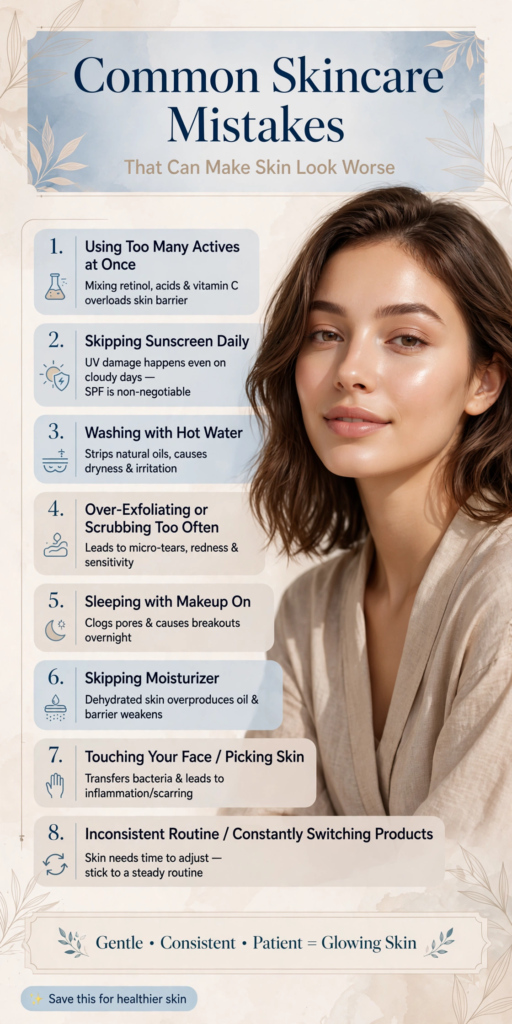
Common Skincare Mistakes That Can Make Skin Look Worse
Using too many active ingredients
More acids and retinoids don’t necessarily mean faster results.
Skipping sunscreen
This makes it harder to protect your skin from ongoing UV exposure.
Scrubbing aggressively
Physical irritation can leave skin uncomfortable and inflamed.
Washing with very hot water
Hot water can worsen dryness and irritation.
Changing products constantly
You can’t evaluate a routine if you replace everything every few days.
Copying someone else’s routine
Someone else’s skin may have completely different needs.
Chasing “perfect” skin
Healthy skin doesn’t have to look poreless or filtered.
Believing every supplement claim
Supplements should not automatically be treated as skincare solutions simply because they are marketed for “radiance,” “glow,” or “anti-aging.”
The competitor supplied for this topic makes strong claims about glutathione and a proprietary ingredient. Those claims should be treated as marketing claims rather than established general skincare advice unless supported by appropriate independent evidence.
For more guidance on choosing and using sunscreen, the American Academy of Dermatology recommends using a broad-spectrum sunscreen with SPF 30 or higher as part of everyday sun protection.
The Bottom Line
So, how do I make my skin beautiful?
Start by making it healthy and comfortable rather than trying to make it perfect.
Use a gentle cleanser, moisturize according to your skin type, protect yourself from the sun every day, add targeted ingredients only when you have a specific reason, and avoid constantly irritating your face with aggressive treatments.
Then give your routine time.
The most useful skincare routine isn’t necessarily the longest, newest, or most expensive one. It’s the one that fits your needs, your lifestyle, and your ability to use it consistently.
FAQs
How can I make my skin beautiful naturally?
Focus on the basics first: sun protection, gentle cleansing, adequate moisturization, a balanced diet, sufficient sleep, avoiding smoking, and minimizing unnecessary irritation. “Natural” does not automatically mean safer or better for skin.
How can I get glowing skin?
Healthy-looking glow generally starts with hydration, a functioning skin barrier, sun protection, and a routine appropriate for your skin type. If dullness persists, a targeted ingredient may help address the underlying concern.
What is the most important skincare product?
For daytime, sunscreen is one of the most important products for protecting skin from UV exposure. A gentle cleanser and appropriate moisturizer are the other foundational products.
Can drinking more water make my skin beautiful?
Adequate hydration supports overall health, but drinking excessive amounts of water isn’t a shortcut to perfect skin. Your complexion depends on many factors, including skincare, sun exposure, genetics, environment, and overall health.
How do I make my face smooth and clear?
Start with gentle cleansing and appropriate moisturization. If acne, clogged pores, or rough texture are persistent, consider a targeted treatment suited to the problem rather than adding several active products at once.
Is expensive skincare better?
Not necessarily. The right ingredients, formulation, consistency, and suitability for your skin matter more than price alone.
How often should I exfoliate?
There is no universal schedule that works for everyone. Sensitive or dry skin may need very little exfoliation, while some oily or acne-prone complexions may tolerate certain exfoliating ingredients better. If you experience irritation, reduce or stop exfoliation until your complexion feels comfortable again.
How can I make my skin look younger?
Daily sun protection, moisturizing, avoiding smoking, and using appropriate evidence-based treatments can help maintain a healthier appearance over time. The AAD identifies sun protection as a particularly important part of preventing premature signs of aging.