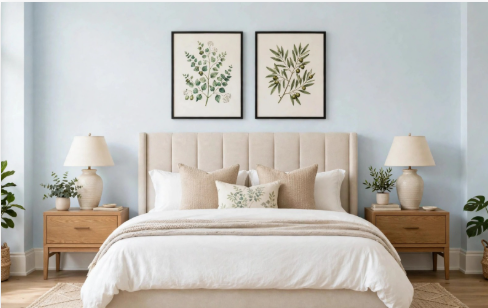
Looking for decoration ideas for above a bed? Think about creating a composition using your bed + wall space rather than focusing on a random object that seems to float on an otherwise empty expanse of wall.
The basic options for most bedrooms are one big piece of art, two pieces of art hung together, a textile wall hanging, wallpaper or wall molding, gallery-style clusters, or something similar. It all depends on your headboard style, the size of the room, overall decorating style, and how much drama the room needs.
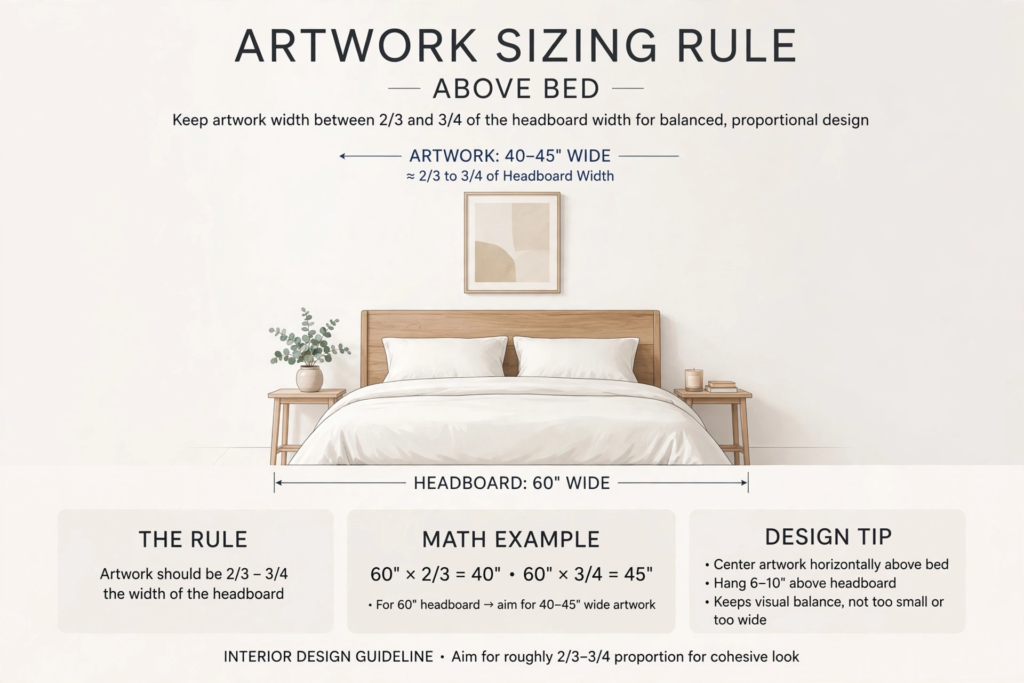
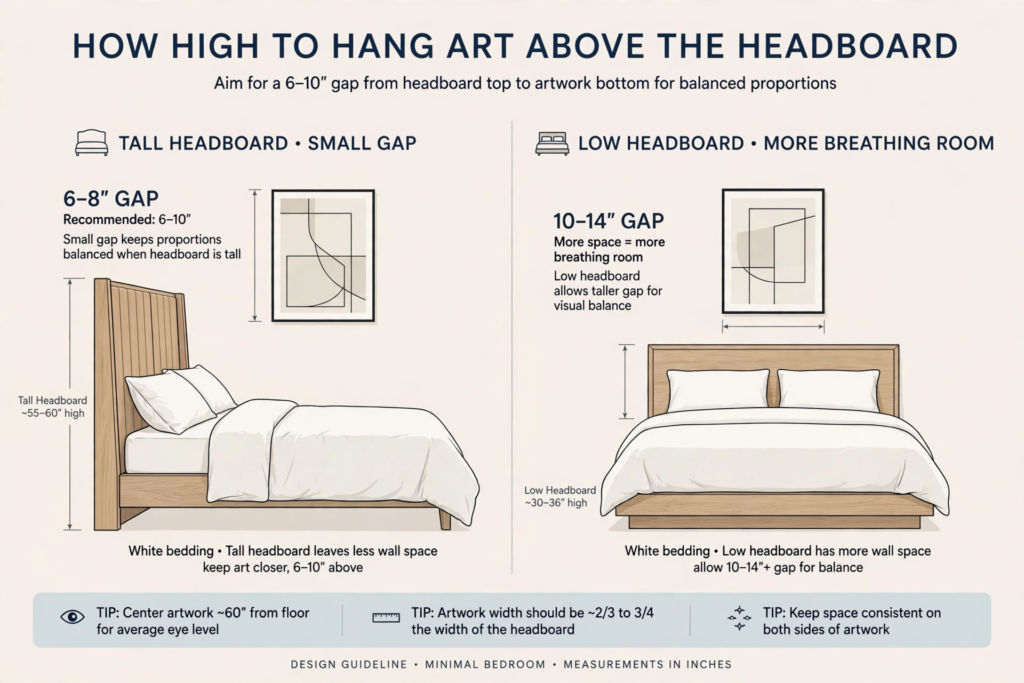
A good rule of thumb is to make the overall size of the artwork or cluster about ⅔ – ¾ the width of the bed/headboard. As for the height, many designers are recommending something like 6-10″ between the top of the headboard and the bottom edge of the art as a starting point. But it should all be based on the room and the piece.
But you don’t have to hang art pictures above a bed — here are 20 ideas for finishing off the space instead! Some are purely decorative, and some lean more towards architectural elements.
For more ideas on creating a cohesive and inviting space, explore our complete guide to [Bedroom Interior Decor: A Step-by-Step Guide to Designing a Stylish Bedroom].
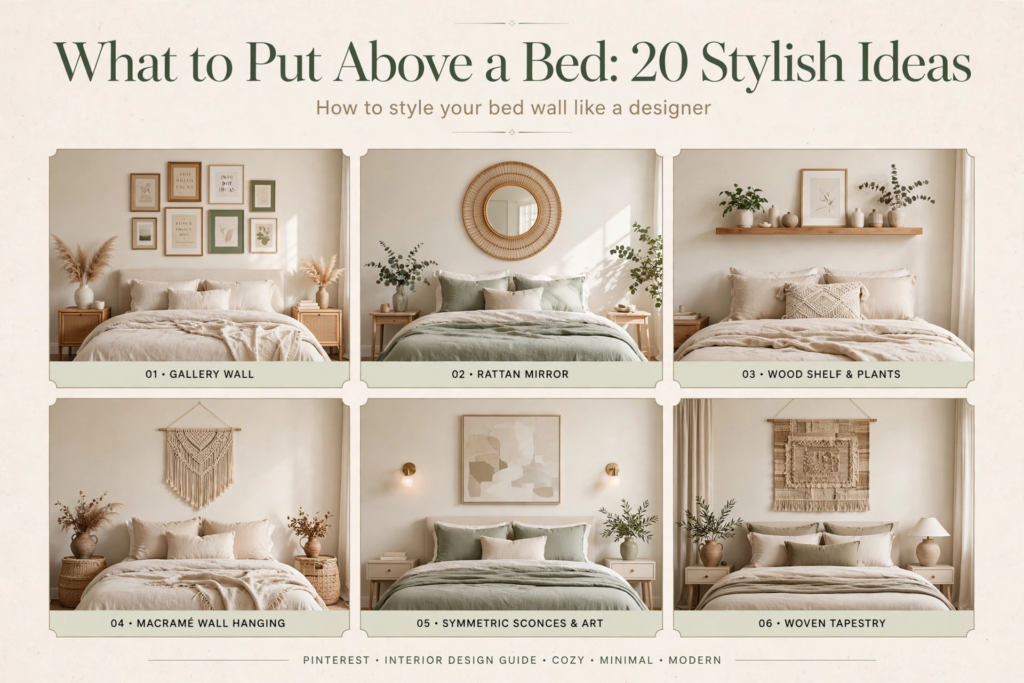
20 Stylish Ideas for What to Put Above a Bed
1. What to Put Above a Bed: Hang One Oversized Piece of Artwork
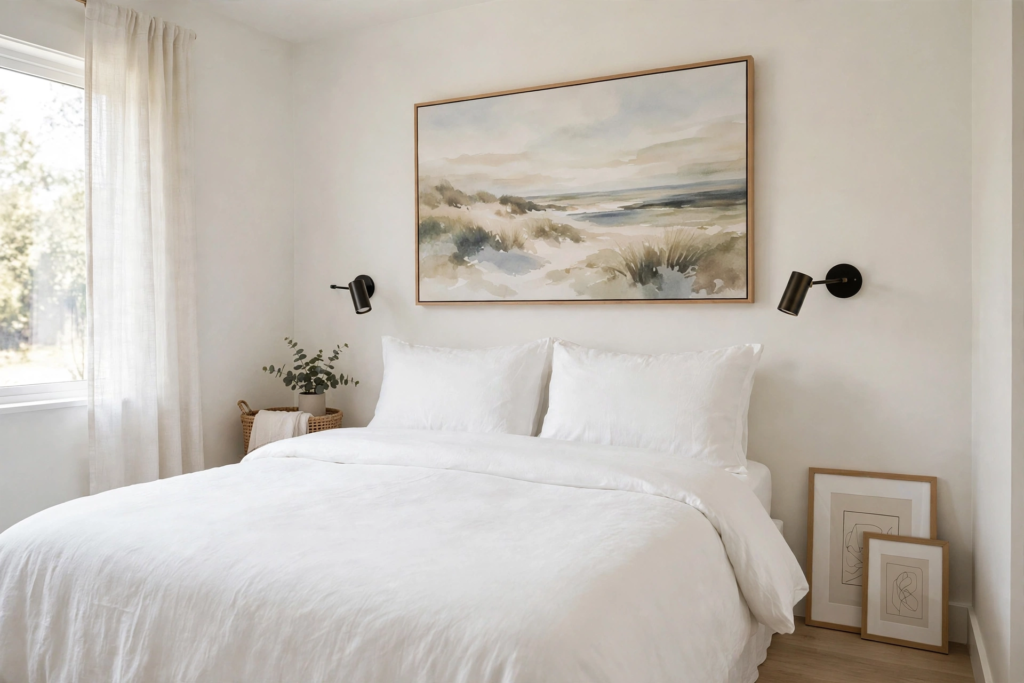
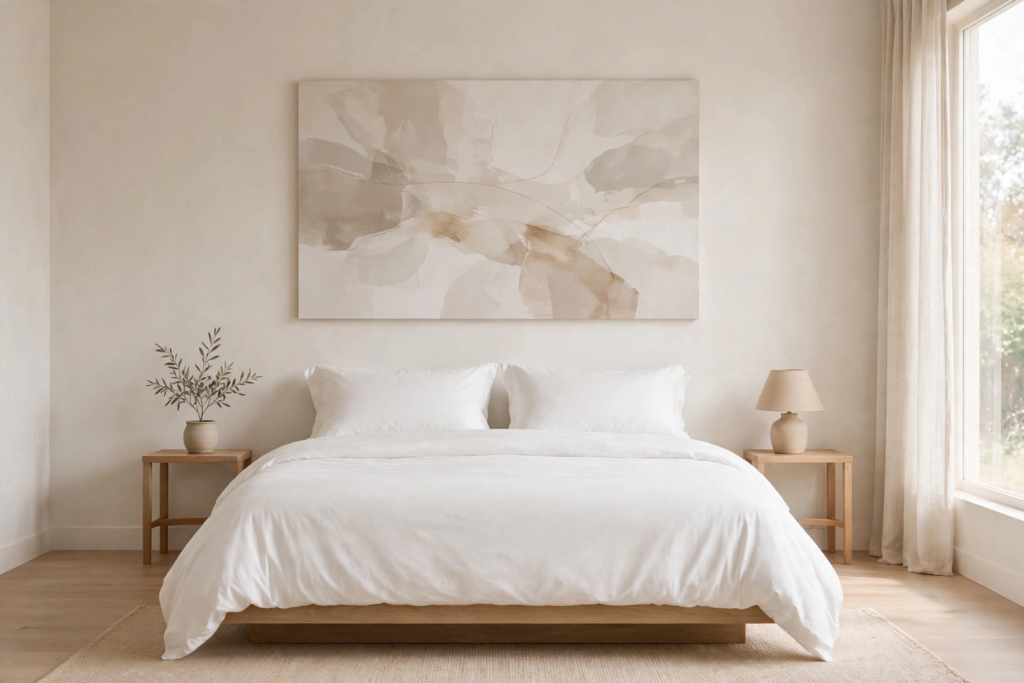
When in doubt, a single large-scale artwork is one of the easiest solutions for what to hang above the bed.
A horizontal painting, abstract canvas, landscape, photograph, or other medium that relates to the piece of furniture below it in some way will do just fine.
The most important thing is to think about scale — a small 12-inch framed piece looks swallowed up by a queen or king-sized bed, while one that’s generously sized will create a nice focal point on the otherwise blank wall.
A good rule of thumb is to find something that will take up two-thirds to three-quarters of the space of the headboard.
This works best in bedrooms with modern, minimalist, transitional, or contemporary furnishings.
If your bed linens are particularly patterned, go with something more subtle in your artwork, and feel free to let the walls reflect more color and pattern if your sheets are simple.
If you’re looking for stylish ways to elevate your space without overspending, explore our guide to [Affordable Luxury Home Decor: 25 Elegant Ideas on a Budget].
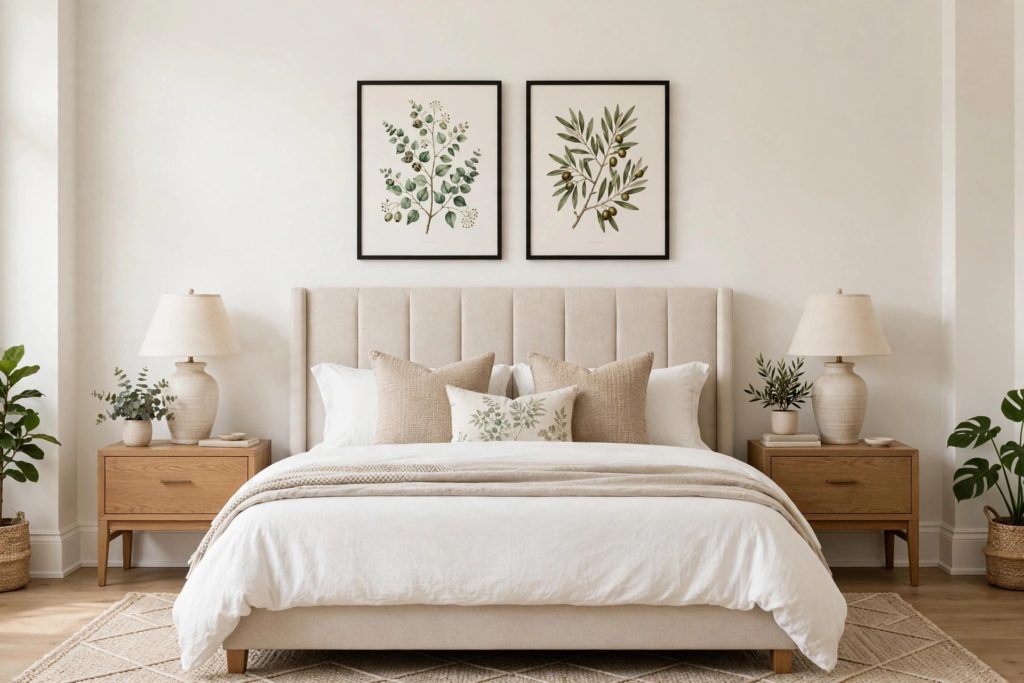
2. What to Put Above a Bed: Use Two Matching Prints
Two matching or coordinating prints make an equally striking alternate to one large-scale piece.
Hang them as a set, and leave enough space between the two so that they appear as one piece, but keep the width proportional to your headboard.
This looks especially good in symmetrical bedrooms where the nightstands and lamps (or sconces) create a balanced look.
Try: botanical prints, landscapes, abstract art, vintage illustrations, or black and white photography.
For more ways to create a sophisticated and timeless space, explore our guide to [Quiet Luxury Home Decor: 25 Elegant Ideas for a Calm, High-End Home].
3. What to Put Above a Bed: Create a Three-Piece Art Set
A triptych gives you the scale of a large artwork without requiring one enormous frame.
The three pieces can be:
- Three sections of one image
- Three related landscapes
- Three abstract paintings
- Three botanical prints
- Three photographs with a shared color palette
Think of the three pieces as one composition.
Keep the overall spread wide enough to relate to the bed, and use consistent frames or a clearly coordinated palette.

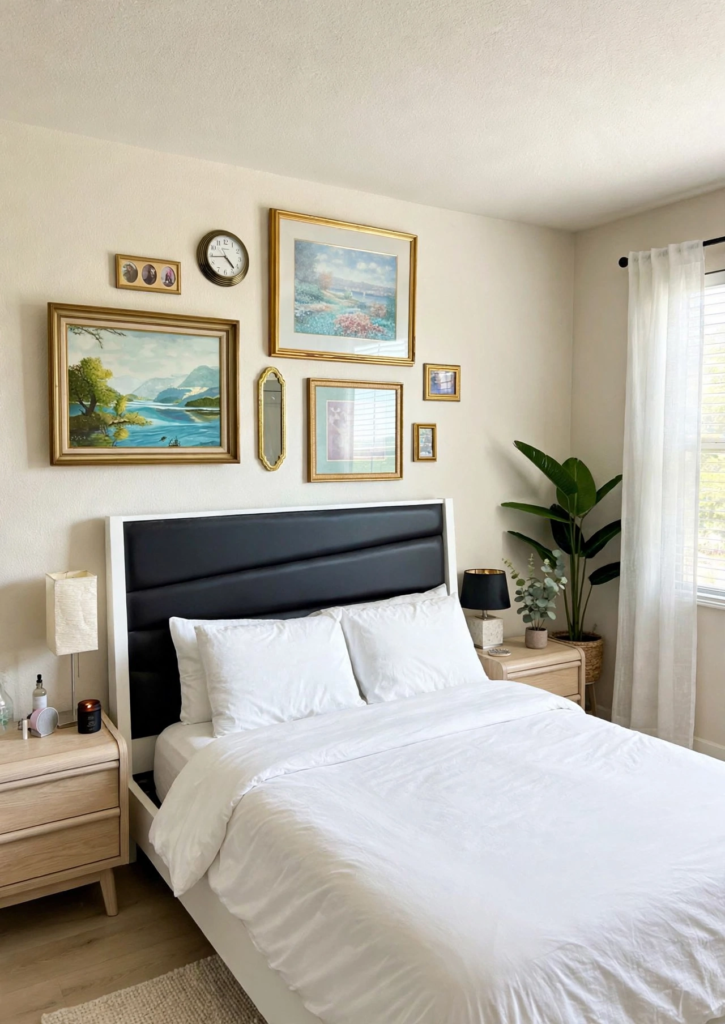
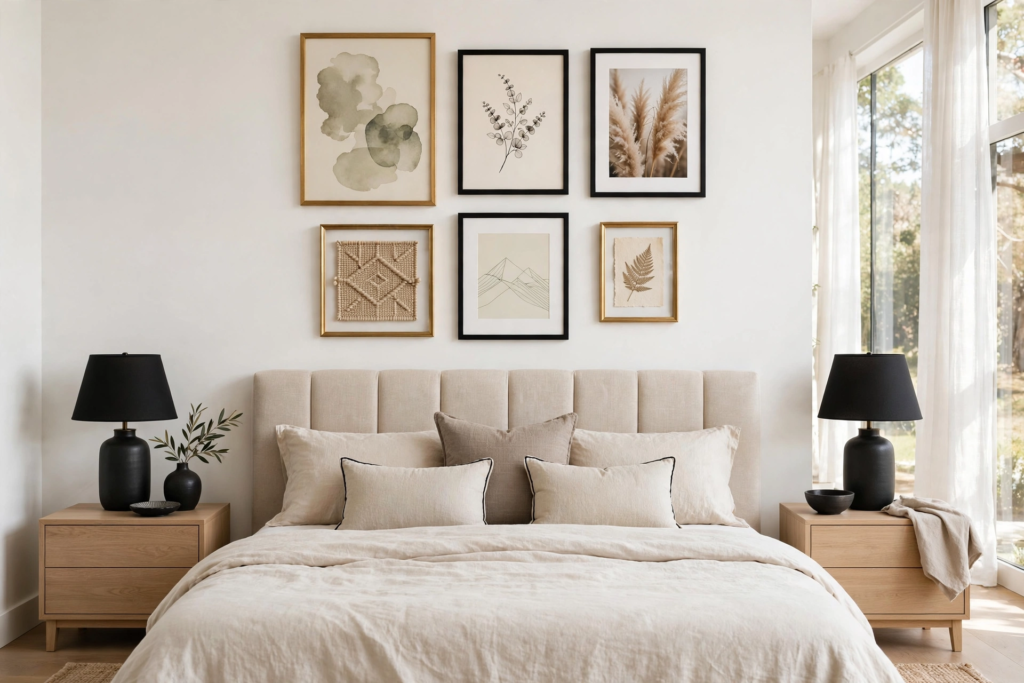
4. What to Put Above a Bed: Build a Small, Carefully Edited Gallery Wall
A gallery wall can work above a bed, but more isn’t automatically better.
Instead of filling every inch, create a compact arrangement with a clear outside shape. Five or six pieces can feel more intentional than fifteen unrelated frames.
A good gallery might combine:
- One medium artwork
- Two smaller prints
- A photograph
- A small textile
- One subtle decorative object
If you use multiple frames, mock up the arrangement on the floor first. You can also cut paper templates and tape them to the wall before making holes.
Best for: collected, traditional, eclectic, and maximalist bedrooms.
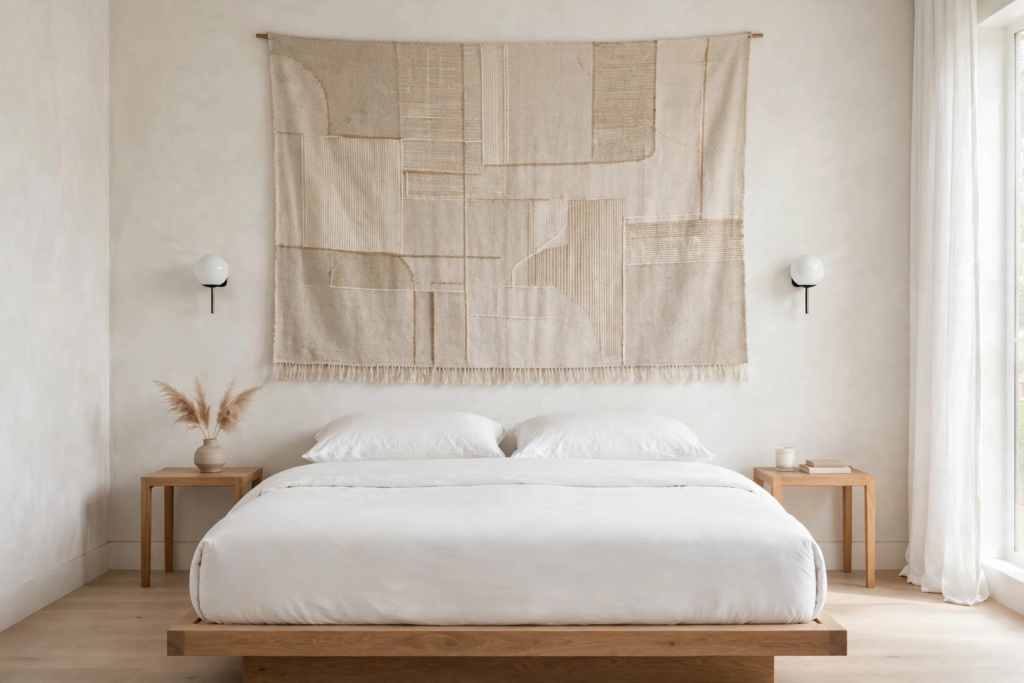
5. What to Put Above a Bed: Hang a Textile or Tapestry
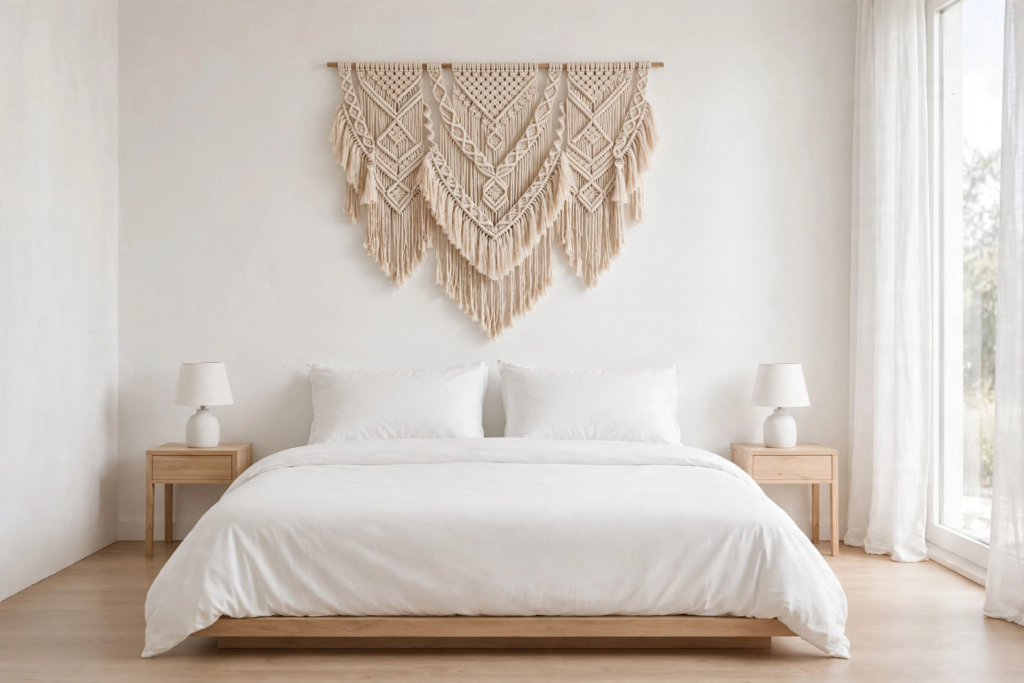
A textile adds something that artwork can’t: softness.
A big woven wall hanging, tapestry, quilt or fabric panel can be used to fill the space without adding another hard, rectangular surface.
It’s especially useful if the bedroom has lots of wood, metal, straight lines or smooth surfaces.
Pick a textile that complements the colors of your bedding, rug, curtains or upholstered furniture.
Ideal for: cozy, bohemian, organic, rustic, eclectic or relaxed bedrooms.
6. Try Woven Wall Decor
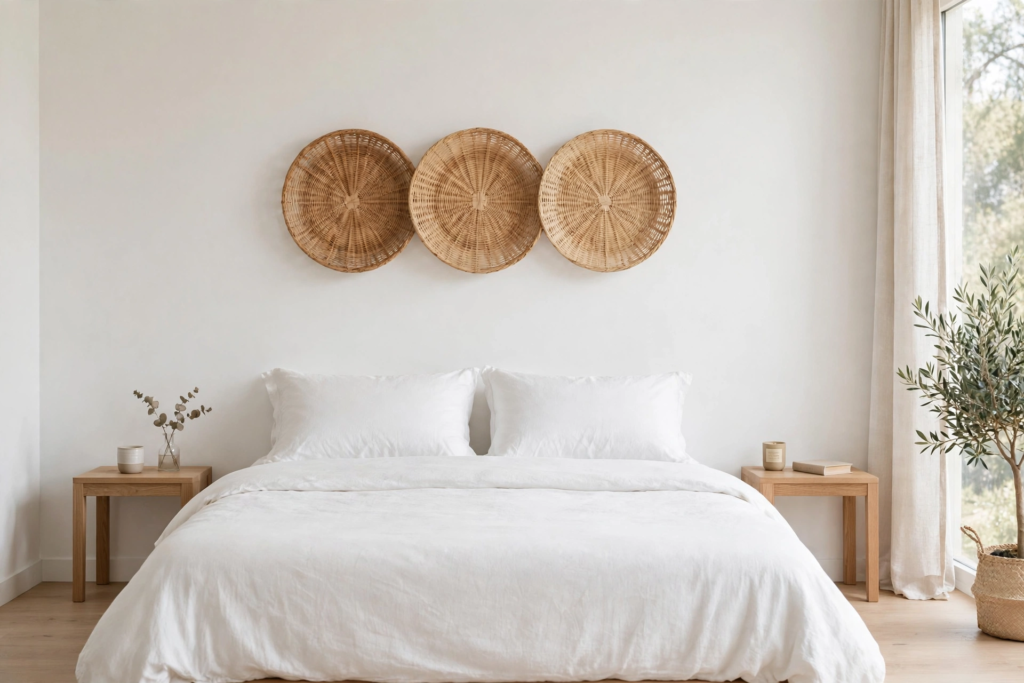
For something a little more on the smaller scale than a giant tapestry, consider woven baskets, rattan discs, fiber art, or other light natural material pieces.
A nice grouping of three makes for a nice wide horizontal without feeling too much like artwork that’s been properly framed, and the rounder shapes will help break up all the rectangles of your bed, headboard, nightstands, etc.
Design tip: Keep it tight, as in a few cohesive pieces will always look better than several unrelated ones.
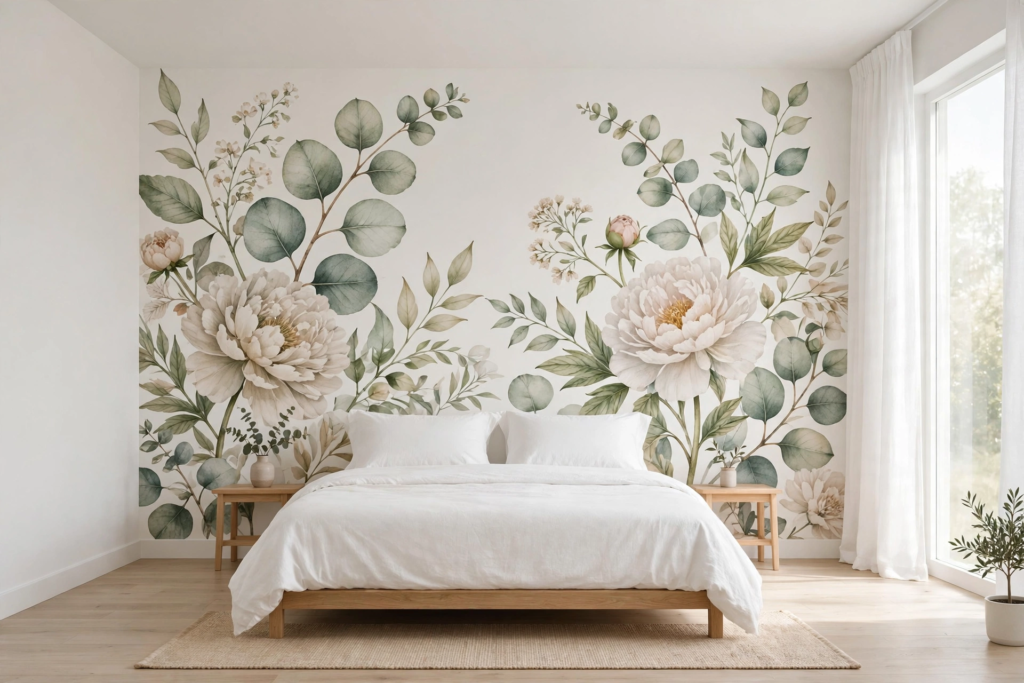
7. Use Wallpaper as the Artwork
You don’t necessarily need an object above the bed.
Wallpaper can turn the entire bed wall into the focal point.
For a calm bedroom, consider:
- Oversized botanical patterns
- Soft geometric designs
- Subtle stripes
- Textured neutrals
- Painterly landscapes
- Large-scale florals
If the wallpaper is visually strong, let the bedding and accessories become quieter.
For renters, removable wallpaper can provide a lower-commitment alternative, although installation and removability vary by product and wall surface.
Current design coverage increasingly treats wallpaper and other wall treatments as complete focal points rather than backgrounds that require additional artwork.
8. Paint an Accent Wall
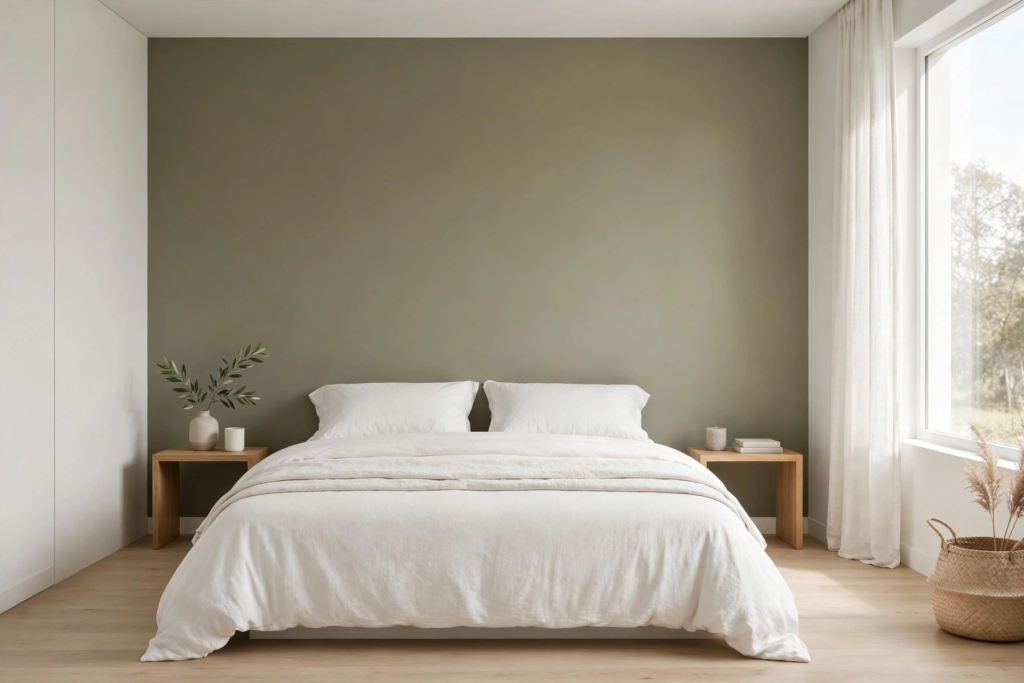
A painted bed wall is one of the simplest ways to answer the question without hanging anything.
Choose a color that creates enough contrast with the rest of the room to define the bed area.
For example:
- Warm white walls + muted olive bed wall
- Pale beige room + deep brown accent
- Soft gray + dusty blue
- Cream + muted terracotta
- White + deep charcoal
The exact color matters less than the relationship between the wall, bedding, flooring, and natural light.
If the room already has a dramatic headboard, a subtle wall color may be more effective than a high-contrast feature.
9. Add Wall Molding or Paneling
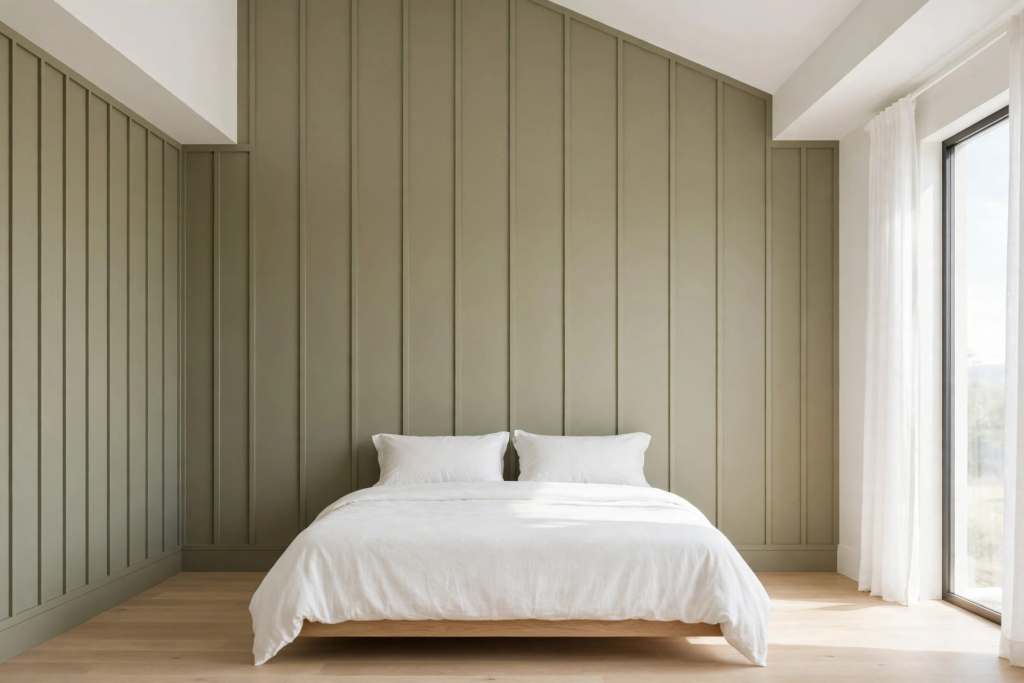
If you want something more architectural, you might want to try panel molding, board-and-batten, beadboard, or some other kind of wall treatment.
That’s a good idea if you have a flat looking bedroom and don’t want to clutter it up with lots of objects.
Another good thing about paneling is that it can help set off your bed as the focal point of the room.
One of the considerations when you’re trying to choose a design is the height of your ceilings. If you want to suggest height, you go with vertical elements. To show off a great width, go with a broad horizontal composition. Contemporary design calls for architectural treatments to act as a visual link between the headboard and the wall.
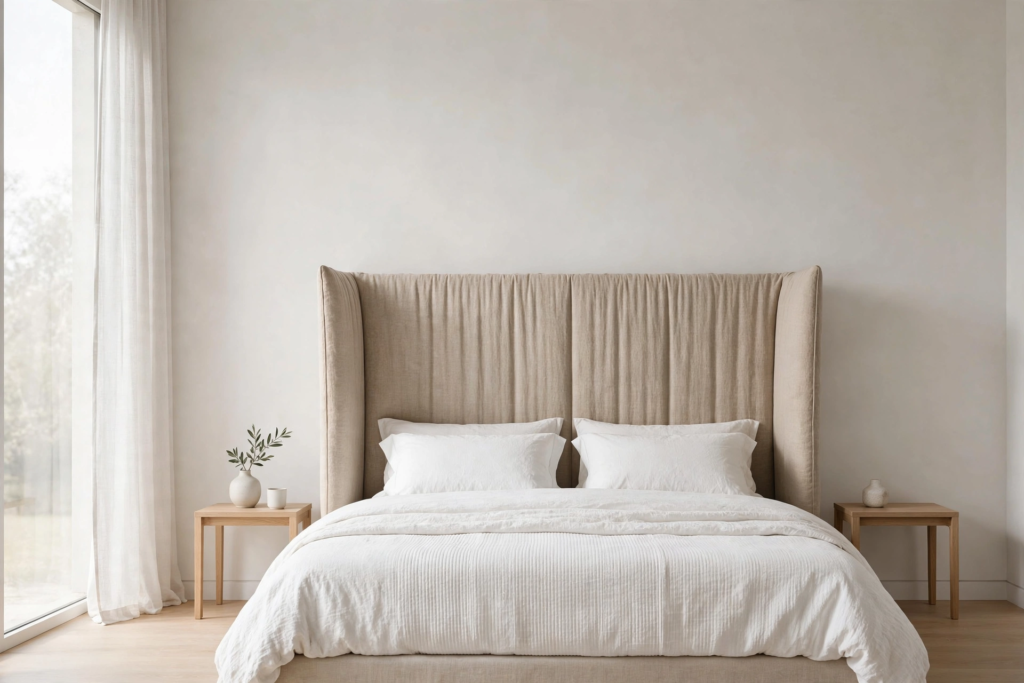
10. Extend an Upholstered Headboard Up the Wall
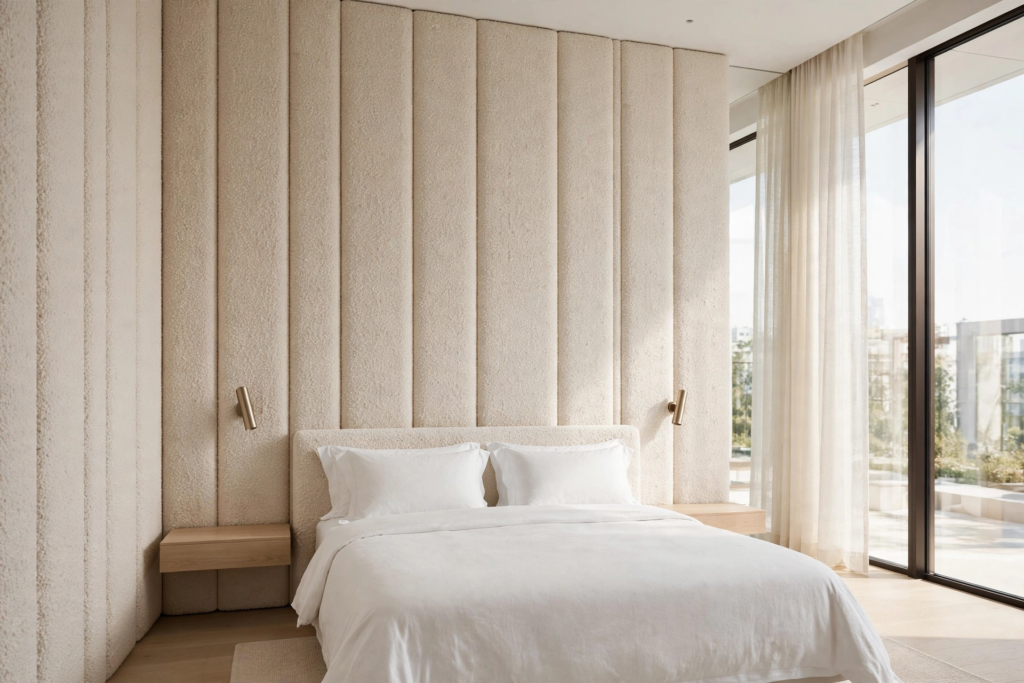
Instead of putting something above the headboard, make the headboard itself extend upward.
Upholstered wall panels can create a soft, hotel-inspired effect and visually merge the bed with the wall.
Try:
- Linen
- Bouclé
- Velvet
- Performance fabric
- Textured neutral upholstery
This can be particularly effective when you want a quiet bedroom without a collection of small decorative objects.
Best for: contemporary, luxury-inspired, transitional, and hotel-style bedrooms.
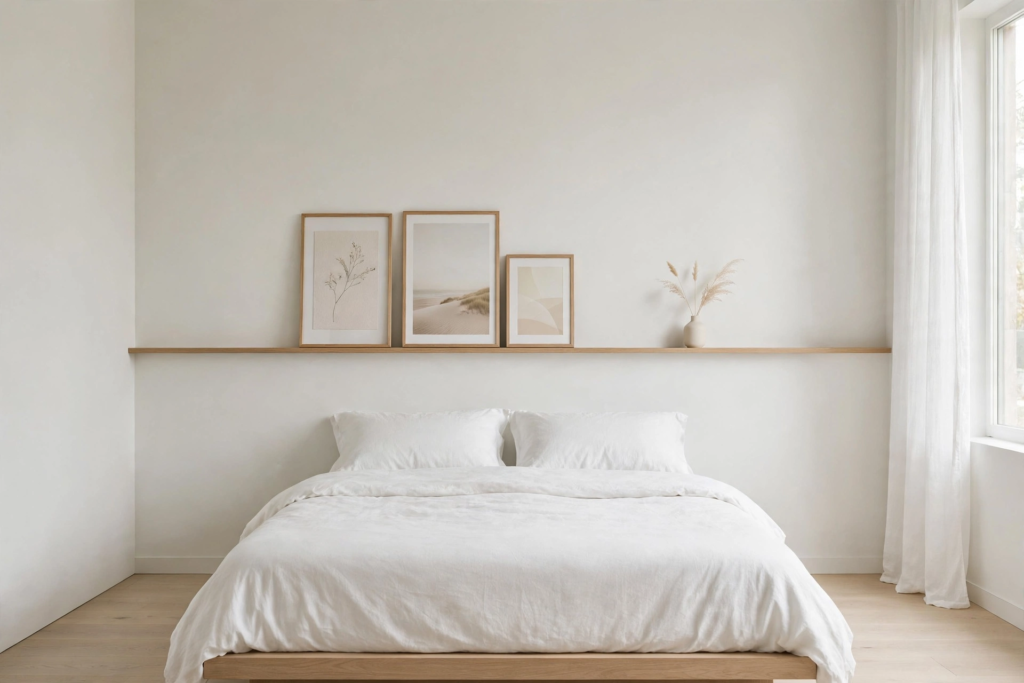
11. Install a Slim Picture Ledge
A picture ledge gives you flexibility.
Instead of committing to a permanent gallery wall, you can lean a few lightweight prints against the ledge and change them when you want a refresh.
Keep the display edited:
- Two or three frames
- One small object
- A restrained color palette
- Plenty of empty space
The flexibility is useful for people who like to change artwork seasonally or frequently. Shelving is also a recurring solution in current above-bed decor coverage, although anything mounted over a bed should be securely installed and not overloaded.
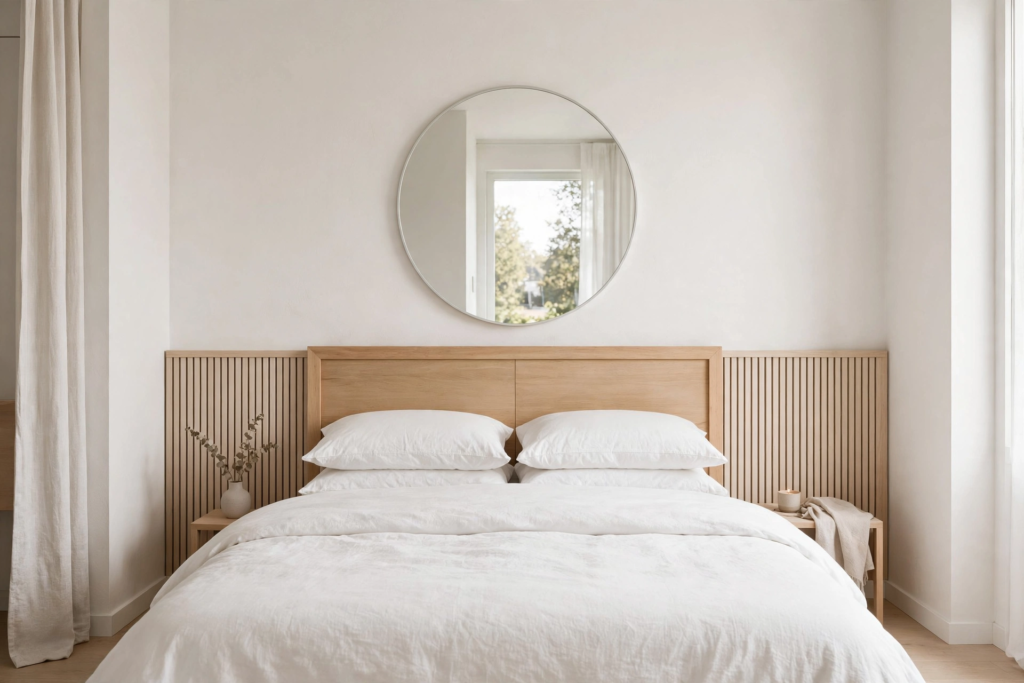
12. Add a Lightweight Mirror
A mirror can introduce reflection and make a small room feel more visually open.
Round, arched, or softly curved shapes can be particularly effective against a rectangular headboard.
However, mirrors deserve more caution than lightweight art because glass can be substantially heavier.
If you choose a mirror over the bed, use hardware appropriate for the mirror’s actual weight and your wall construction. If that feels uncomfortable, put the mirror on the opposite wall or above a dresser instead.
There is also a purely personal consideration: some people simply don’t like having a reflective surface overhead. In that case, artwork or textile decor is an easy alternative.
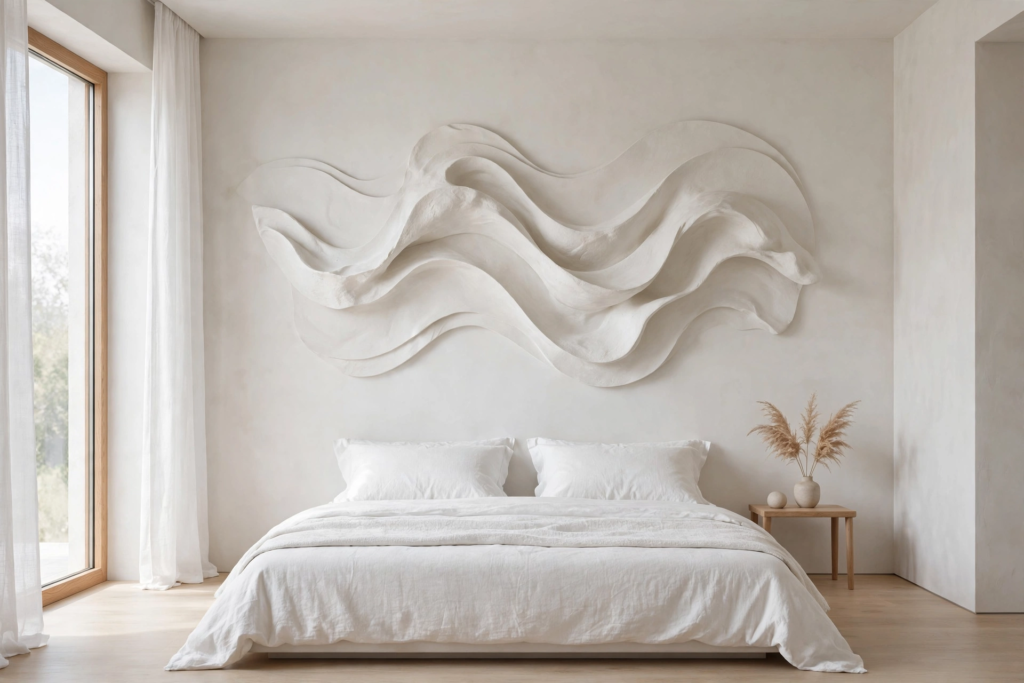
13. Hang a Sculptural Wall Piece
A sculptural object can give a bedroom more dimension than a flat print.
Consider:
- Carved wood
- Metal line art
- Plaster-inspired pieces
- Organic-shaped wall sculpture
- Woven relief
- Lightweight architectural forms
Keep the piece visually simple if the bedroom already contains strong patterns.
And remember that “sculptural” doesn’t mean “heavy.” Above a bed, lightweight construction is generally preferable.
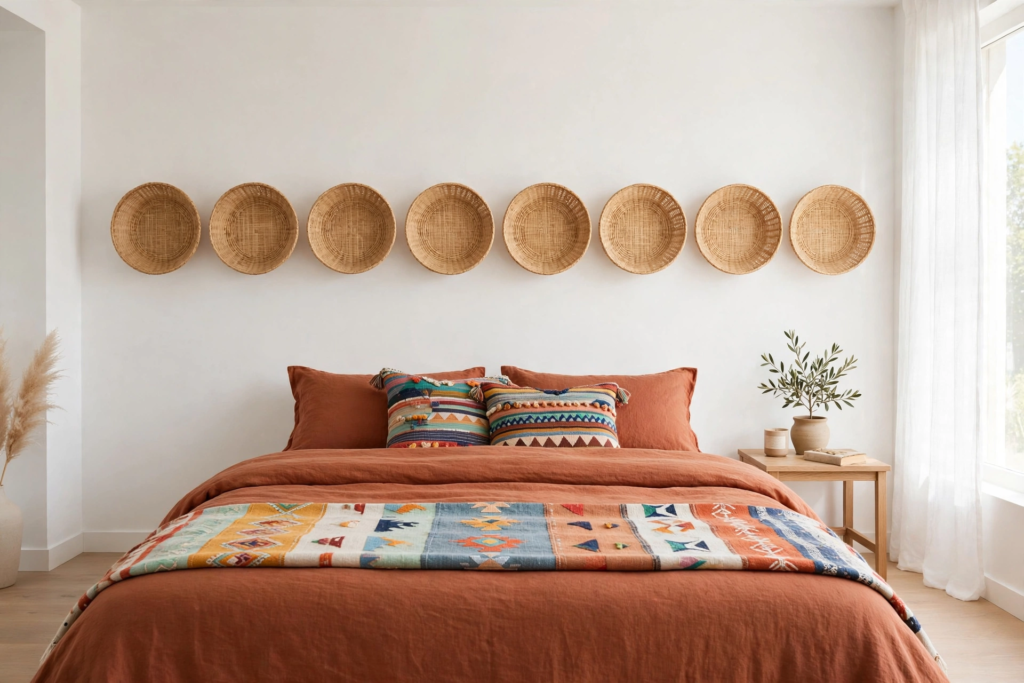
14. Arrange Decorative Baskets
A collection of shallow woven baskets can create a warm, organic focal point.
Choose baskets that share something—material, color, shape, or texture—so the arrangement looks curated rather than random.
A horizontal grouping often works particularly well because it follows the width of the bed.
This option is especially useful when you want texture but don’t want traditional artwork.
15. Display a Personal Collection
Your bed wall doesn’t have to look like a showroom.
Consider displaying a meaningful collection such as:
- Vintage botanical prints
- Family photographs
- Travel photography
- Small textile pieces
- Antique-looking maps
- Collected illustrations
- Meaningful artwork
The strongest collections usually have a visual connection. That connection might be color, frame style, subject matter, or simply a consistent sense of scale.
The goal isn’t to make everything match. It’s to make the collection feel intentional.
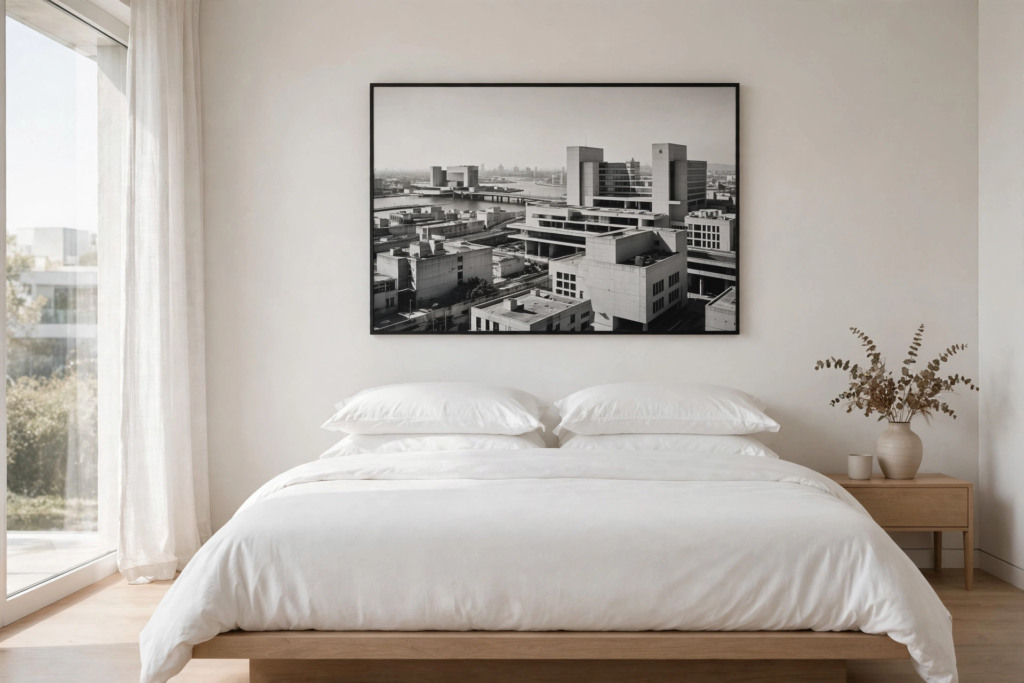
16. Use Black-and-White Photography
Black-and-white photography is useful when you want personality without introducing many new colors.
A large photograph can create a sophisticated focal point while remaining relatively restrained.
Good subjects include:
- Architecture
- Landscapes
- Portraits
- Botanical photography
- Travel images
- Abstract details
Pair the photography with a simple frame if the room already has plenty of texture.
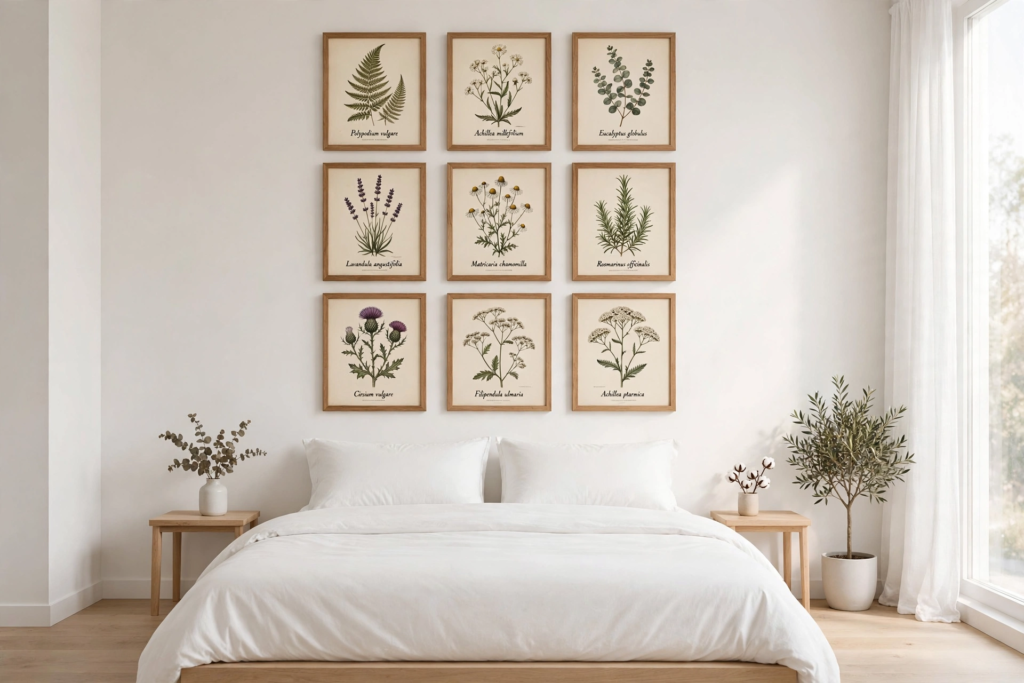
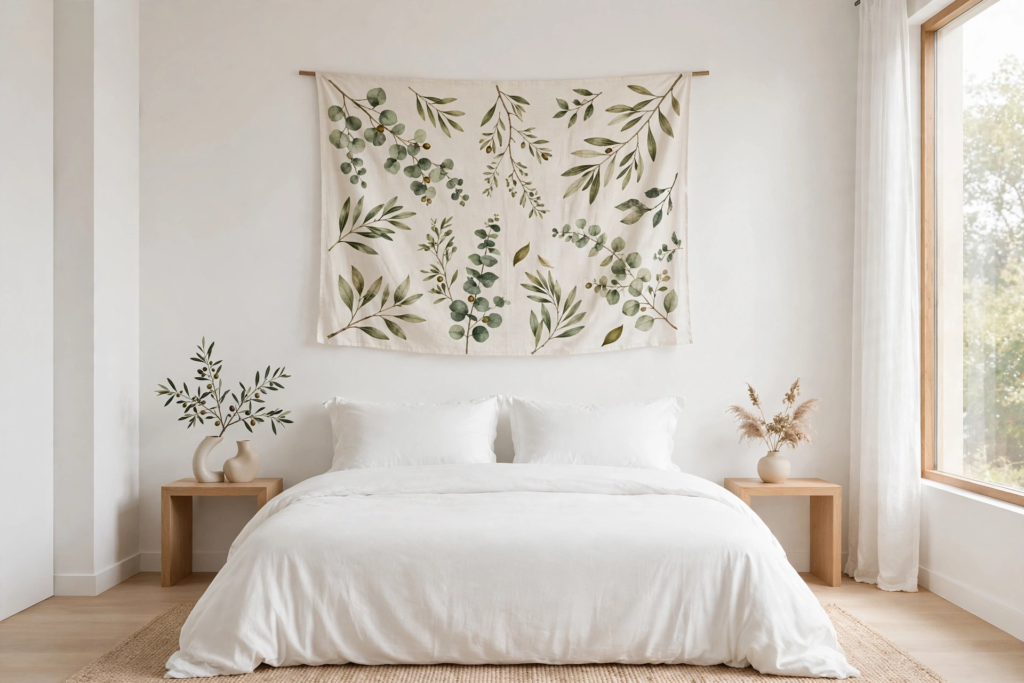
17. Create a Botanical or Nature-Inspired Display
Plants can bring organic shapes into a room dominated by rectangular furniture.
Instead of putting a heavy planter directly above the bed, consider:
- Botanical prints
- Pressed-botanical artwork
- Lightweight artificial foliage
- A textile featuring botanical motifs
- A wall-mounted botanical illustration
If you use actual plants, keep heavy pots and containers away from positions where they could fall onto the bed.
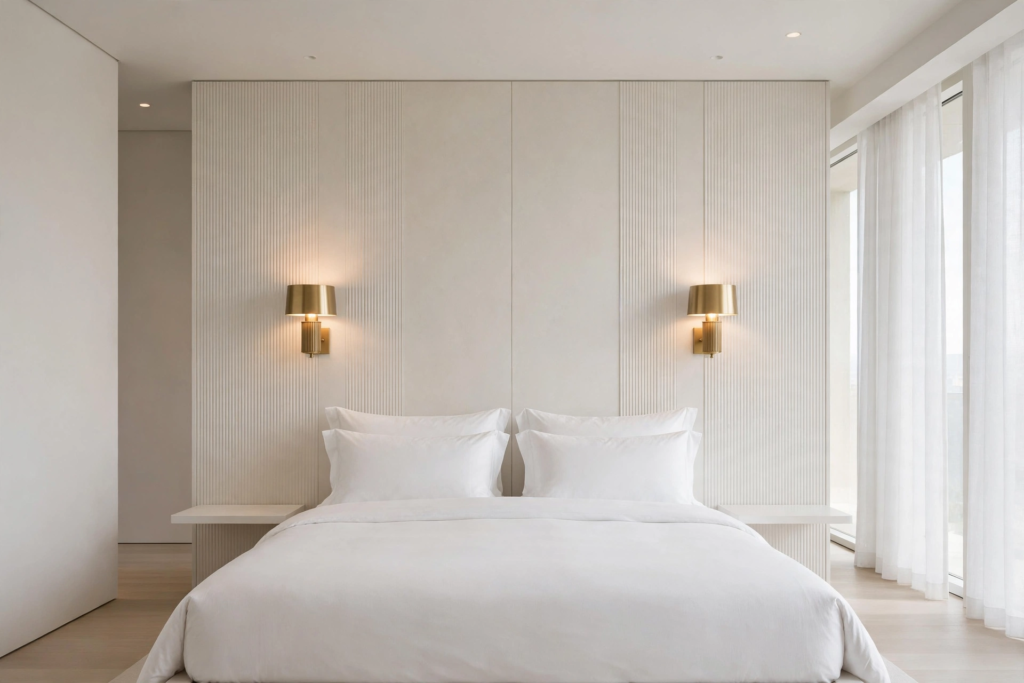
18. Use Wall Sconces as the Main Feature
Who says the wall above a bed needs artwork?
A pair of wall sconces can provide both decoration and useful bedside lighting.
Place them symmetrically around the bed and choose a finish that relates to other hardware in the room.
This works particularly well when:
- Nightstands are small
- You want to free tabletop space
- You like hotel-style bedrooms
- You want layered lighting
- The headboard already provides visual interest
Current design coverage identifies statement wall lighting as an alternative to conventional artwork for above-bed decoration.
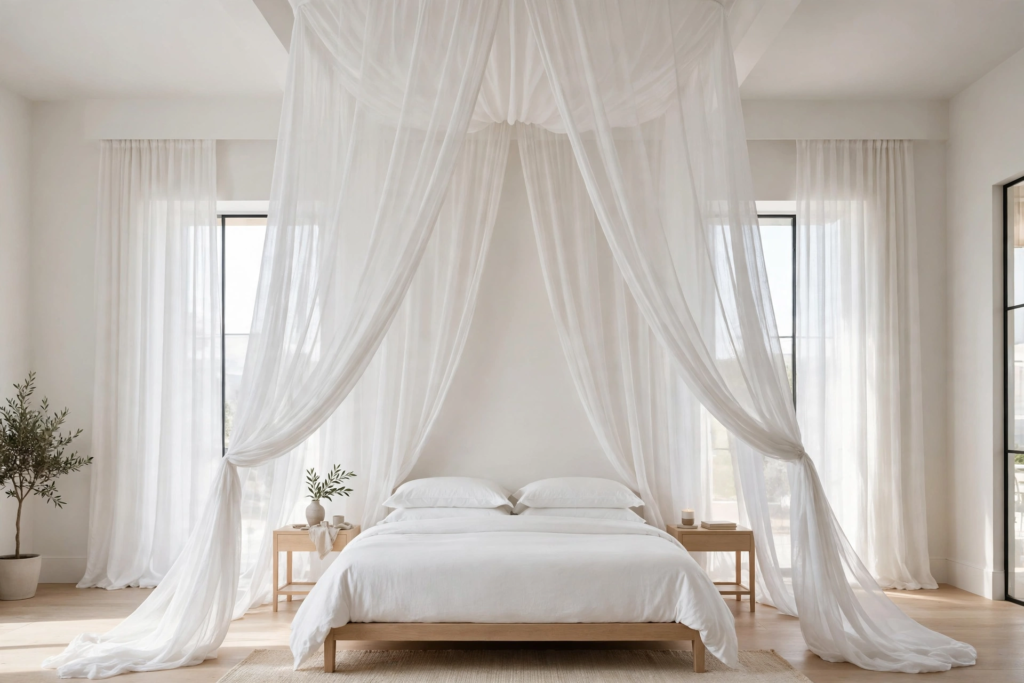
19. Frame the Bed With Drapery or a Canopy Effect
If you want a romantic or dramatic bedroom, fabric can do more than simply hang on the wall.
A canopy frame, curtain panels, or carefully installed drapery can visually frame the bed and add height.
This works particularly well in bedrooms with:
- Tall ceilings
- Four-poster beds
- Large windows
- Traditional architecture
- Romantic or boutique-hotel styling
Keep the installation secure and make sure fabric doesn’t interfere with lighting, ceiling fans, or other fixtures.
20. Leave the Wall Blank
This is the idea most decorating lists forget.
You don’t have to fill the wall simply because it’s empty.
A blank wall can work beautifully when:
- The headboard is tall or dramatic
- Bedding provides enough texture
- Wallpaper already creates interest
- The room is minimalist
- The bedroom is small
- You want a calm visual field
If the room already feels balanced, negative space can be part of the design rather than evidence that something is missing.
How Big Should Decor Above a Bed Be?
A useful starting guideline is to make the total width of your artwork or arrangement about two-thirds to three-quarters of the headboard width.
For example, if a headboard is approximately 60 inches wide, an arrangement around 40–45 inches wide gives you a reasonable starting point.
That’s a design guideline—not a hard rule.
You can adjust it depending on:
- The height of the headboard
- Ceiling height
- Width of the wall
- Size of bedside tables
- Visual weight of the artwork
- Whether sconces flank the bed
- Whether the wall is patterned
The important thing is that the decor should feel connected to the bed, not like a small object floating somewhere near the ceiling. Current guides repeatedly identify scale as one of the biggest factors in making above-bed decor look intentional.
Quick sizing guide
| Bed/Headboard | Starting art width |
|---|---|
| Twin | About 26–30 in |
| Full | About 36–40 in |
| Queen | About 40–45 in |
| King | About 50–60 in |
These are styling starting points, not mandatory dimensions. Measure your actual headboard before buying anything.
How High Should You Hang Art Above a Headboard?
A commonly used starting point is approximately 6–10 inches between the top of the headboard and the bottom of the artwork. Several current guides use a similar range.
Don’t force the number if your room’s proportions say otherwise.
For example:
- A very tall headboard may need a smaller gap.
- A low-profile headboard may tolerate more breathing room.
- A low ceiling may require you to keep the arrangement visually compact.
- A very tall ceiling may allow a taller artwork.
The objective is simple: the artwork and headboard should read as one group.
What If You Don’t Have a Headboard?
You can absolutely decorate above a bed without one.
Without a headboard, the mattress and bed frame become your visual reference point.
Good choices include:
- A wide tapestry
- Oversized artwork
- A wallpaper panel
- Painted molding
- A large textile
- A shallow wall treatment
- Symmetrical sconces
Without the vertical anchor of a headboard, avoid placing a small piece high on the wall. It can make the bed feel visually disconnected from the decor.
A painted rectangle or wallpaper panel can also act as a visual substitute for a headboard, giving the wall a defined zone without adding furniture.
What Works Best in a Small Bedroom?
Small rooms generally benefit from fewer, better-scaled elements.
Instead of filling the wall with tiny frames, consider:
- One large horizontal artwork
- One textile
- A simple painted accent wall
- A narrow picture ledge
- A compact pair of prints
- A wall-mounted lighting solution
Current small-bedroom coverage similarly emphasizes one appropriately scaled focal element rather than scattering numerous small decorations across the wall.
If floor space is limited, wall-mounted lighting can also provide function without consuming nightstand or floor space.
What Works Best in a Rental?
For renters, prioritize solutions that don’t require major construction.
Options include:
- Removable wallpaper
- Lightweight textiles
- Lightweight unframed art
- Carefully selected removable hanging systems where appropriate
- A freestanding or leaning decorative element placed somewhere other than directly over the bed
- A statement headboard
- Paint, if your lease allows it
Don’t assume every adhesive product is appropriate for every object or wall. Follow the manufacturer’s weight, surface, and installation requirements.
For anything heavy above a sleeping position, a secure mechanical installation is generally a more appropriate approach than relying casually on adhesive strips.
“For additional inspiration, explore Architectural Digest’s bedroom decorating ideas for more examples of artwork and above-bed styling.”
Above-Bed Decorating Mistakes to Avoid
1. Choosing art that’s too small
This is probably the most common visual problem.
A beautiful little frame can still look lost above a large bed.
2. Hanging the artwork too high
If there’s a huge gap between the headboard and artwork, they stop reading as one composition.
3. Centering on the wall instead of the bed
If the bed isn’t centered on the wall—or the wall has an architectural feature—use the actual bed composition as your reference.
4. Adding too many competing focal points
A dramatic wallpaper, giant artwork, elaborate bedding, ornate headboard, and large gallery wall can all compete.
Choose a hierarchy.
5. Ignoring visual weight
A tiny frame and a massive headboard won’t balance the same way as a substantial artwork and a low-profile bed.
6. Treating safety as an afterthought
Above-bed decor is physically different from ordinary wall decor because someone sleeps directly underneath it.
Use appropriate hardware for the wall type and object weight, and don’t overload shelves or use heavy objects casually overhead. Current guidance increasingly emphasizes this point.
7. Decorating simply because the wall is empty
Sometimes the best choice is to leave it alone.
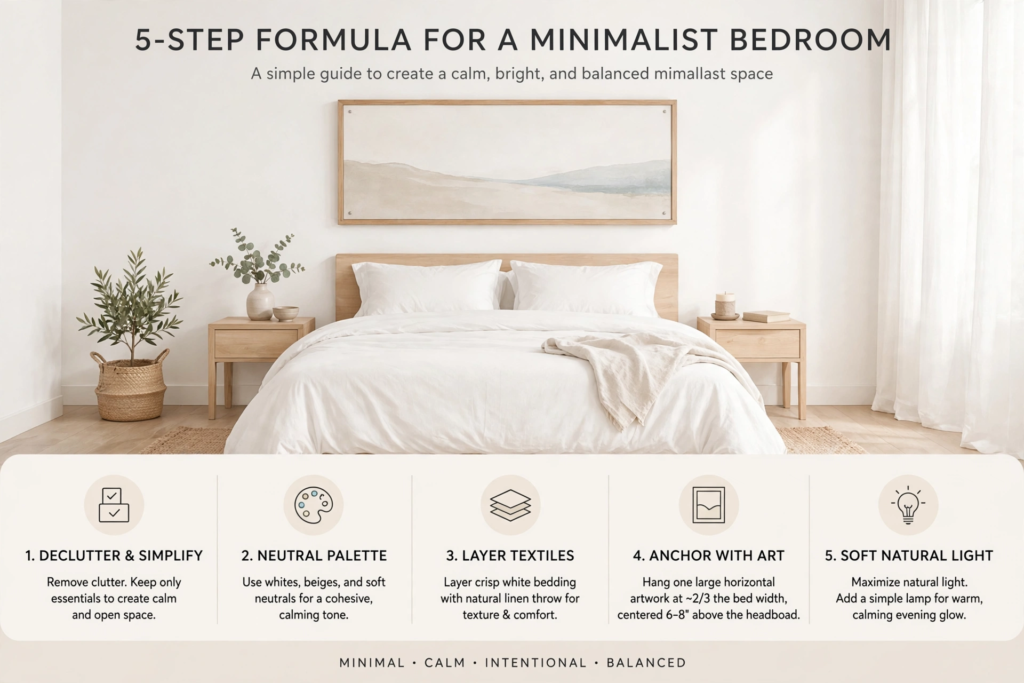
A Simple Formula for Choosing What Goes Above Your Bed
If you’re still stuck, use this five-step process:
Step 1: Look at the headboard.
Is it tall and decorative or short and plain?
Step 2: Look at the wall.
Is it narrow, wide, tall, low, plain, or already patterned?
Step 3: Choose your visual goal.
Do you want art, texture, architecture, storage, lighting, or simplicity?
Step 4: Check the scale.
Aim for a composition that relates clearly to the width of the bed or headboard.
Step 5: Check the weight and installation.
Anything positioned above the sleeping area should be securely and appropriately mounted.
If you follow those five steps, choosing between artwork, textiles, wallpaper, paneling, sconces, or leaving the wall blank becomes much easier.
Bottom Line
The best thing to put above a bed isn’t necessarily the most expensive artwork or the trendiest wall decor. It’s the option that fits the scale of the bed, supports the room’s style, and gives the wall a clear visual purpose.
For an easy starting point, try oversized artwork. texture, choose a textile. Architectural impact, consider wallpaper or paneling. A rental, look at removable treatments and lightweight decor. And if your headboard or bedding already makes a statement, don’t be afraid to leave the wall mostly blank.
The goal isn’t to fill the wall.
It’s to make the bedroom feel finished without making the bed wall feel c
FAQs
What is the best thing to put above a bed?
Popular options include oversized artwork, coordinated prints, textiles, wallpaper, paneling, sconces, and mirrors. The best choice depends on the bed’s scale, headboard, room style, and how much visual weight the bedroom already contains.
What size art should go above a bed?
A practical starting point is artwork or a grouped arrangement about two-thirds to three-quarters of the headboard width. Adjust according to the room’s proportions rather than treating the ratio as a strict rule.
How high should art be above a headboard?
A common starting range is about 6–10 inches between the top of the headboard and the bottom of the artwork. The exact spacing should account for the headboard height, ceiling, artwork size, and overall composition.
Can you put a mirror above a bed?
Yes, but consider the mirror’s weight and mounting method carefully. Because a mirror can be substantially heavier than lightweight artwork, use hardware appropriate for the wall and mirror rather than treating it like a simple picture frame.
What can I put above a bed instead of art?
Try a tapestry, woven wall hanging, wallpaper, painted accent wall, wall molding, upholstered panels, sconces, or a carefully chosen lightweight sculptural piece.