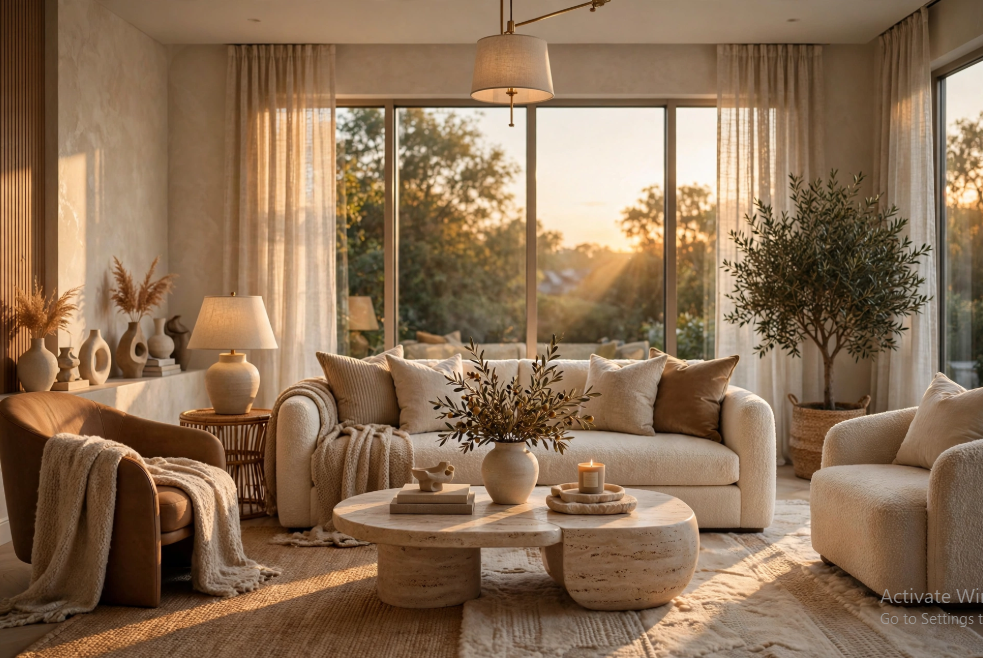
Why your room looks unfinished can be confusing, especially when you already have furniture, decor, and plenty of personal touches. Often, the problem is not that you need more things—it may be the layout, scale, lighting, rug size, color balance, or lack of visual connection between different elements. The good news is that a few simple changes can make your room feel more balanced, polished, and complete without starting from scratch.
Do you have the sofa? And the rug? Perhaps even some tasteful artwork and accessories?
What else could you possibly need to complete the space? Usually, it’s not more furnishings.
Rooms can be filled with furniture and feel incomplete due to an absence of balance, scale and proportion, lighting, color repetition, texture, focal points and statement-making details, or even just a matter of style.
Current decorating advice is beginning to reflect this problem as a cohesion issue rather than something you can fix by buying more. New design guidance also reveals that we as consumers are often actually looking to improve balance, layering or other elements, over and above the furnishing purchasing function.
The best part is, you don’t necessarily have to buy new furnishings to discover what may be lacking
How to spot what you’re missing is explained here
For more ideas on making the most of a small space, check out Small Apartment Decor Ideas That Don’t Feel Cramped for stylish ways to create a comfortable, functional room.
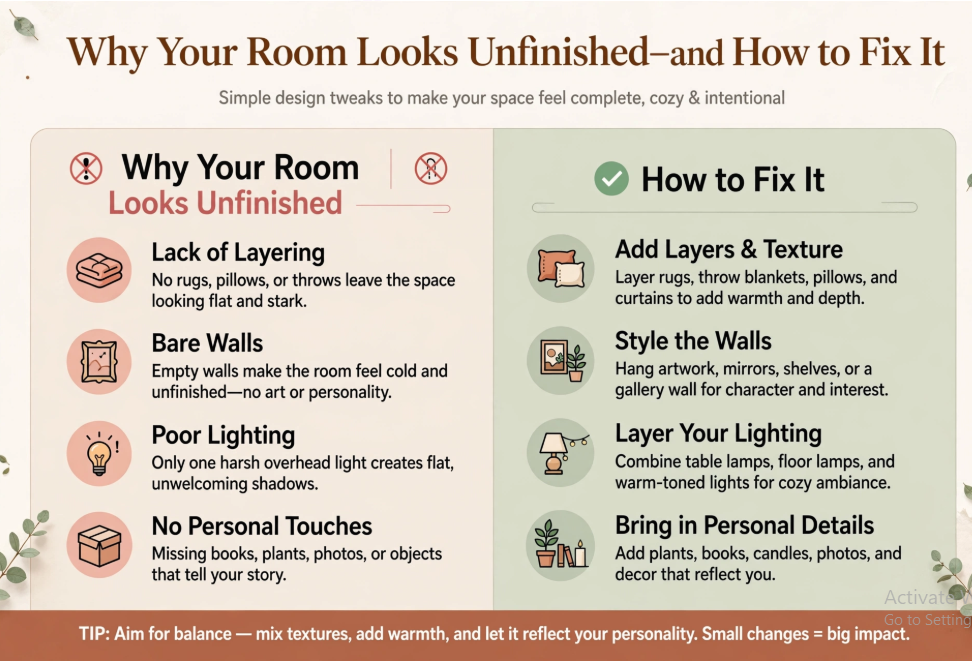
First, Know the Difference Between Empty and Unfinished
This is an important distinction.
An empty room has an absence of used space.
An unfinished room has elements that lack relationship with the visual components.
For instance, a large bedroom with an empty corner is not necessarily unfinished as the corner can be used as a negative space.
As opposed to a bedroom with all furniture, nightstands and beautiful bedding which could be considered unfinished due to the lack of relationship between the bed and the space around it with the stark lighting, bare walls, and harsh illumination.
You do not need to fill every empty space.
A recent home decorating debate perfectly exemplifies this concept of emptiness in decoration; a resident moved furniture and a decorative plant from an unused corner and found the room more agreeable without the items.
So, ask yourself:
Is this space asking for something, or do I object to the emptiness of it?
An important distinction.
If you want to refresh your space without spending more money, explore Home Decor Ideas Without Buying Anything for simple ways to rearrange, restyle, and reuse what you already have.
1. Why Your Room Looks Unfinished: Your Furniture Layout May Be the Problem
Before buying another decorative object, look at your furniture.
Stand in the doorway and take a photograph of the room.
Now ignore the accessories.
Look only at the major shapes:
- Sofa
- Chairs
- Bed
- Tables
- Cabinets
- Rug
- Media console
Do they form a clear composition?
Or are they scattered around the perimeter?
Look for dead space
A room can feel empty when the furniture creates an accidental void.
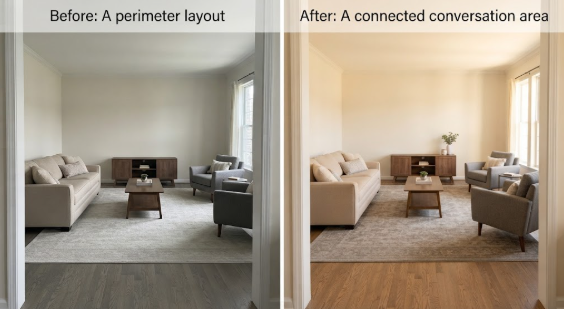
Especially in a living room, having all the pieces pushed along the walls can result in a ring of objects around the edges with one large, disconnected area of space in the middle.
Recent room-layout advice specifically calls out this kind of space as something that can make the room feeling empty despite a large amount of contents within.
Try rearranging the furniture first before getting any new pieces.
Make a conversation area.
Sightly turn a chair towards the sofa.
Put a coffee table closer to the group.
Make connections in your furniture, rather than individual pieces.
Quick test
Get rid of all small things in the room mentally.
If the larger pieces are disconnected, your decor isn’t the issue yet.
Fix the layout first.
If you’re unsure where to begin, How to Decorate Your Home When You Don’t Know Where to Start can help you choose a starting point and build a more cohesive look step by step.
2. Why Your Room Looks Unfinished: Your Rug May Be Too Small
One of the easiest ways to create a cohesive look in a furnished room is by selecting an area rug that unifies the furniture arrangement.
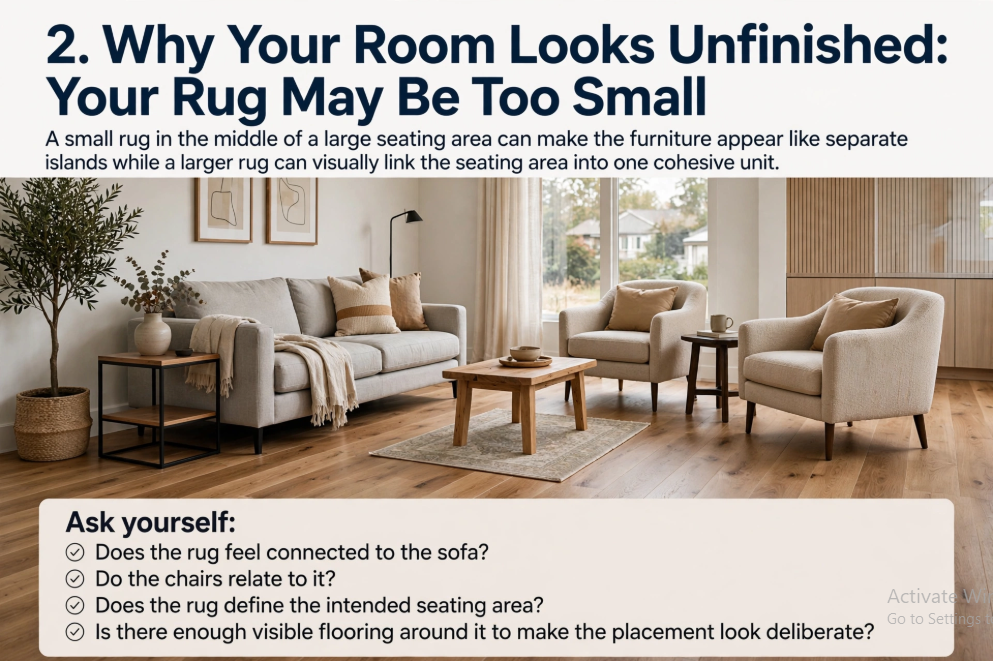
A small rug in the middle of a large seating area can make the furniture appear like separate islands
while
a larger rug can visually link the seating area into one cohesive unit.
However, this will depend on how much the furniture can be placed around the rug and how much space the furniture itself takes up. That means that instead of buying a rug based on a certain dimension, you should rather focus on how much of your furniture can be involved in the rug.
Ask yourself:
- Does the rug feel connected to the sofa?
- Do the chairs relate to it?
- Does the rug define the intended seating area?
- Is there enough visible flooring around it to make the placement look deliberate?
A larger rug isn’t automatically better.
The point is connection, not maximum coverage.
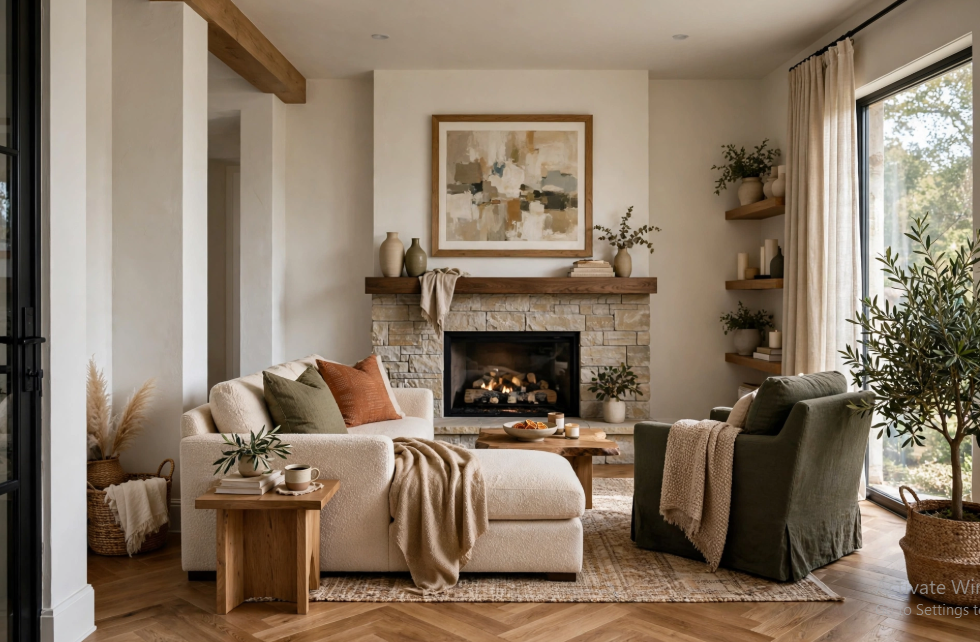
3. Why Your Room Looks Unfinished: Nothing Is Creating a Focal Point
When everything in a room has the same visual importance, the eye doesn’t know where to settle.
That can make the room feel unfinished even when it contains attractive pieces.
A focal point might be:
- Fireplace
- Large artwork
- Statement sofa
- Bed
- Architectural feature
- Large window
- Beautiful view
- Media wall
You don’t necessarily need to buy something dramatic.
Sometimes you simply need to arrange the existing furniture so the room’s best feature becomes more obvious.
Try this
Stand at the entrance.
What do you notice first?
If the answer is:
“Honestly, nothing.”
the room may need stronger visual hierarchy.
Current design coverage repeatedly identifies focal points and visual hierarchy as important parts of making a room feel resolved.
If your space feels dull or lacks personality, explore How to Make a Boring Room Look Better: 15 Simple Fixes for easy decorating ideas that can make a noticeable difference.
4. Why Your Room Looks Unfinished: Your Walls Are Missing Visual Weight
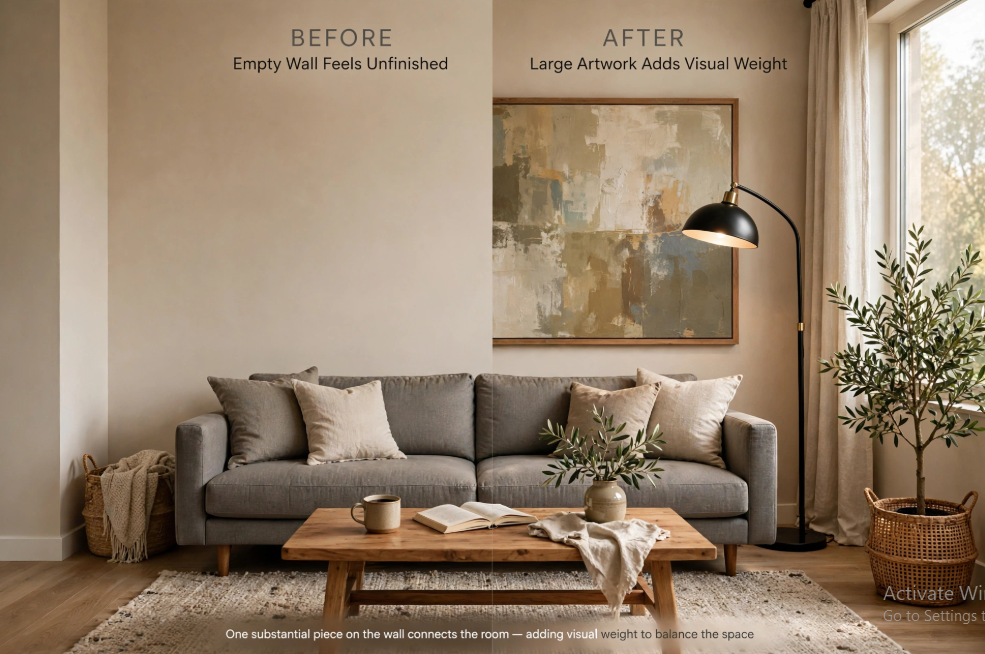
A room can be completely furnished and still look unfinished because the vertical surfaces have been ignored.
Think about how much visual area your walls occupy.
If the room contains:
- sofa
- coffee table
- rug
- lamp
but the walls are almost completely empty, the lower half of the room can feel disconnected from the upper half.
But don’t fill every wall
The answer isn’t to buy six small prints tomorrow.
Instead, choose the walls that matter most.
Good candidates might include:
- The wall behind a sofa
- The wall behind a bed
- A dining-room focal wall
- A large blank wall facing the entrance
One substantial piece can sometimes have more impact than several tiny pieces scattered around the room.
Recent search results specifically emphasize artwork as a way to connect furniture to the surrounding wall and create a stronger visual anchor.
5. Why Your Room Looks Unfinished: Your Lighting Is Too Flat
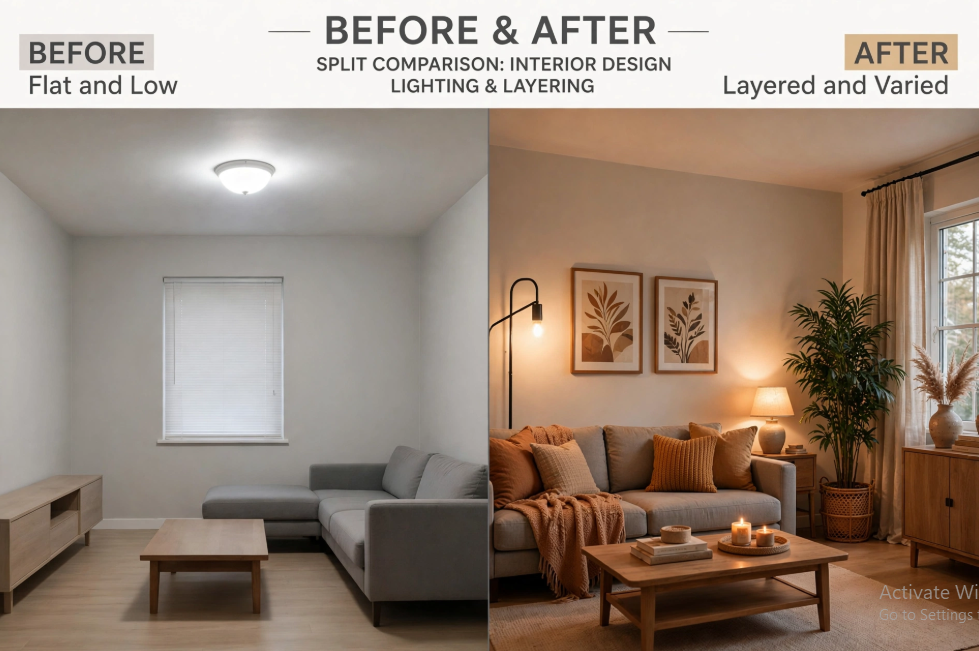
Lighting is one of the easiest things to overlook because a room can technically be “bright enough” while still feeling unfinished.
If the only meaningful light source is an overhead fixture, the room may lack depth in the evening.
Try thinking in layers:
Ambient light
The general illumination of the room.
Task light
Light where you actually do something—reading, working, cooking or getting ready.
Accent light
Lighting used to emphasize a corner, artwork, shelf or architectural feature.
You don’t necessarily need all three types in every room.
But having more than one source can make a space feel considerably more intentional.
Current discussions about unfinished rooms frequently mention additional lamps and varying lighting heights as missing elements.
A simple upgrade
Instead of immediately replacing your ceiling fixture, try adding:
- One floor lamp
- One table lamp
- Or a pair of smaller lamps where appropriate
Then use them in the evening instead of relying exclusively on the overhead light.
6.Why Your Room Looks Unfinished: Everything Is the Same Height
Look around the room.
Are all your major objects low?
For example:
- Low sofa
- Low coffee table
- Low cabinet
- Low rug
- Low accessories
If everything sits around the same visual level, the room can feel flat.
You don’t need dramatic furniture.
Create variation with:
- Floor lamps
- Curtains
- Tall plants
- Bookcases
- Artwork
- Mirrors
- Taller decorative objects
The goal is to give the eye somewhere to move vertically.
This is one reason layered rooms often feel more developed than rooms where everything occupies the same horizontal band.
7. Why Your Room Looks Unfinished: The Room Needs More Texture
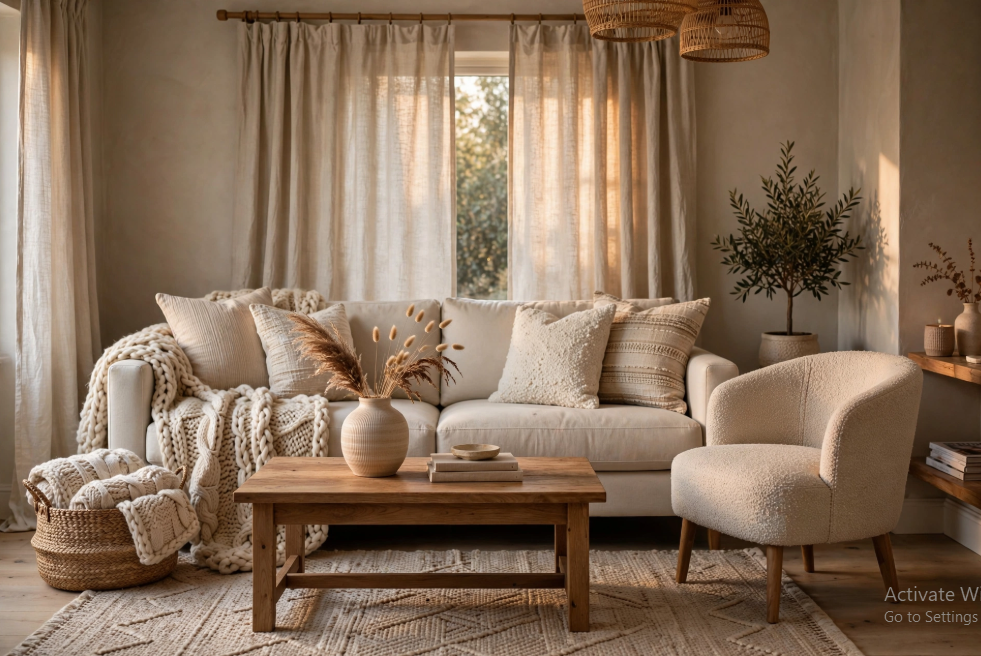
Texture becomes particularly important in neutral rooms.
Imagine a room containing:
- Smooth painted walls
- Smooth sofa
- Flat rug
- Simple curtains
- Glossy table
- Minimal accessories
Nothing is necessarily wrong.
But the room may feel visually flat.
Now introduce some variation:
- Woven basket
- Linen curtain
- Chunky throw
- Wood surface
- Ceramic object
- Textured rug
- Upholstered chair
The room doesn’t need to become busy.
It simply needs different surfaces for light and your eye to interact with.
Recent interior-design guidance similarly frames texture as a major contributor to visual depth.
Don’t count textures
You don’t need to follow a rigid “seven textures per room” rule.
Instead, ask:
Does everything feel like it has the same visual surface?
If yes, introduce one or two contrasting materials.
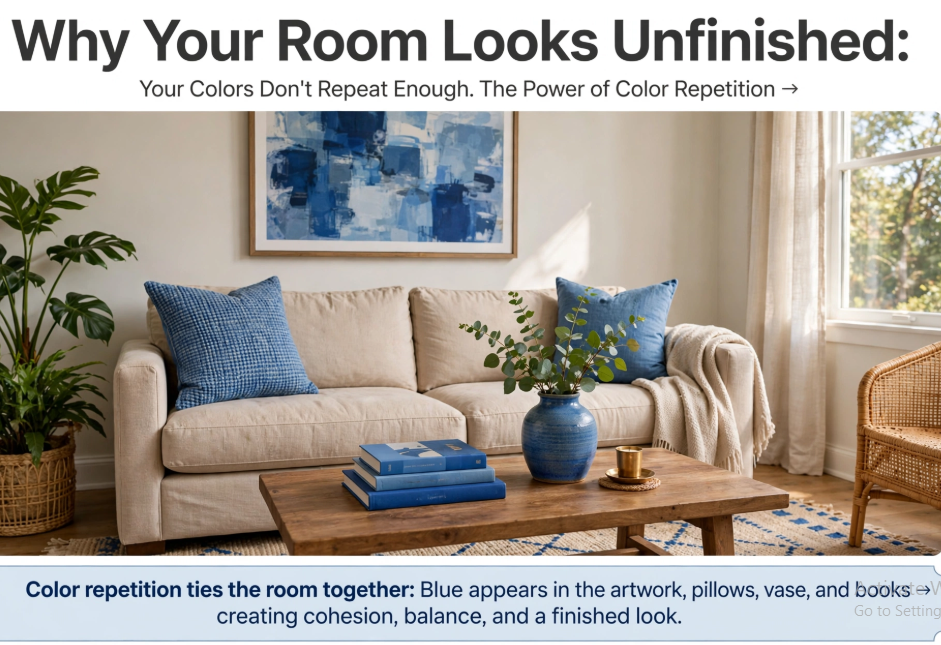
8.Why Your Room Looks Unfinished: Your Colors Don’t Repeat Enough
Your room doesn’t need to be perfectly color matched.
But colors usually feel more intentional when they appear more than once.
Imagine:
- Blue artwork
- Beige sofa
- Brown table
- Green plant
If the blue appears nowhere else, it may look like a random addition.
Now repeat a related blue in:
- A pillow
- A small accessory
- A book
- A secondary piece of artwork
The connection doesn’t have to be exact.
Think repetition, not matching
You want colors to echo one another.
The same principle works with materials.
If you have warm wood in your furniture, repeating a related warm wood tone elsewhere can help the room feel connected.
9. Why Your Room Looks Unfinished: Your Windows Look Bare
Windows are frequently overlooked because they aren’t technically “decor.”
But they occupy a large part of a room’s vertical composition.
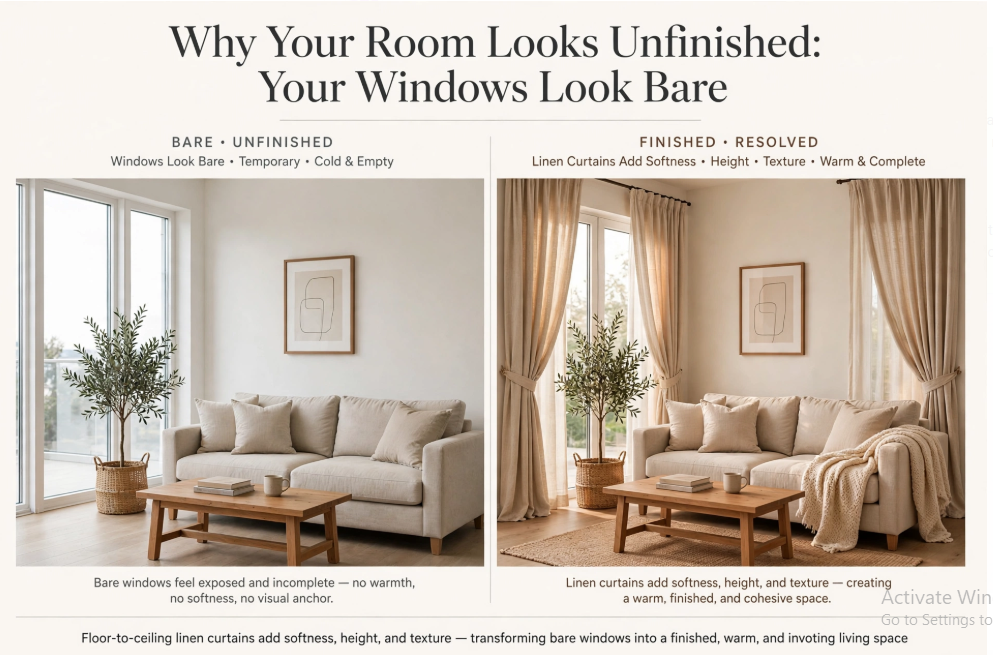
A furnished room with completely bare windows can sometimes feel more temporary or incomplete than the same room with appropriately chosen window treatments.
Curtains can add:
- Softness
- Height
- Texture
- Color
- Visual framing
Current design coverage specifically highlights window treatments as one of the finishing layers that can make a room feel more resolved.
But don’t add curtains automatically
If you have beautiful architectural windows, exceptional natural light, or a minimalist space, bare windows may be completely intentional.
Again, diagnose rather than decorate by formula.
10. Why Your Room Looks Unfinished: You Have Decor—but No Personality
This is a subtle problem.
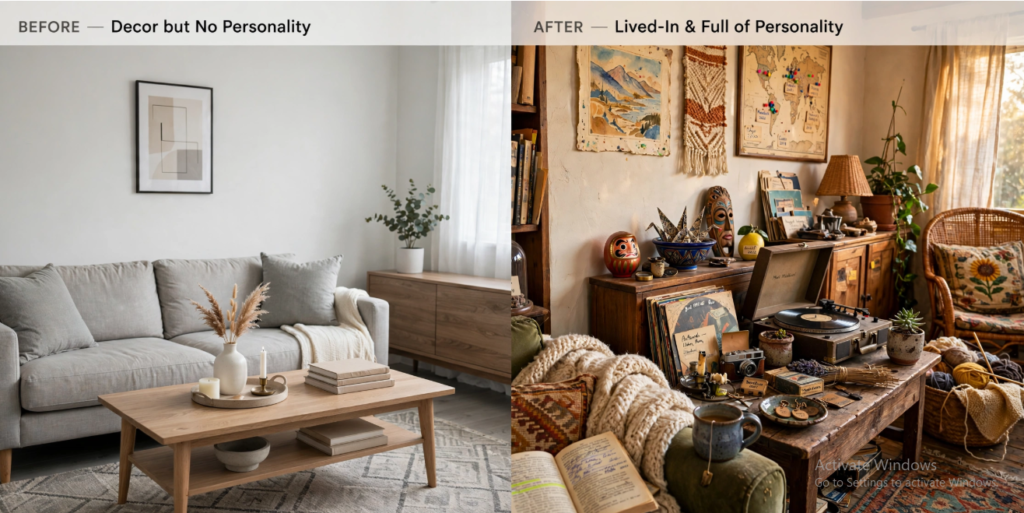
A room can contain plenty of decorative objects and still feel generic.
You might have:
- Decorative tray
- Vase
- Candle
- Pillow
- Plant
- Coffee-table book
But if every object could have been purchased for a staged model home, the room may lack identity.
Add things that tell people something about the person who lives there:
- Books you actually read
- Family photographs
- Travel finds
- Handmade objects
- Vintage pieces
- Artwork you genuinely like
- Collections
- Meaningful souvenirs
A room doesn’t need to be perfectly styled to feel finished.
It needs to feel owned.
Recent design commentary similarly emphasizes personality and meaningful objects rather than trying to make every room look like a showroom.
11. Why Your Room Looks Unfinished: You’re Trying to Fill Every Empty Corner
This is where decorating can go wrong.
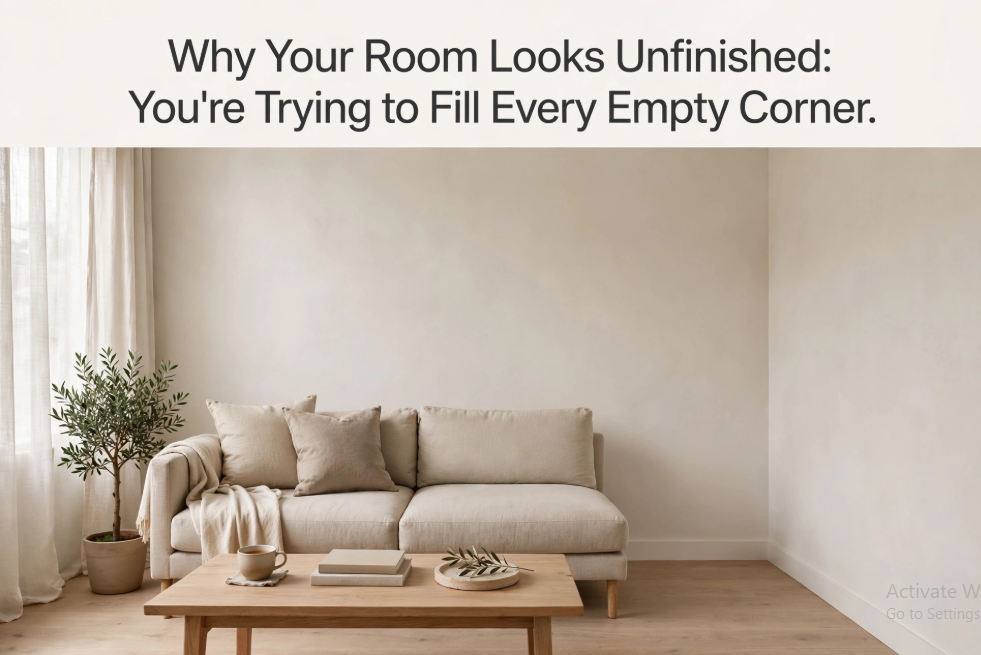
An empty corner can be:
- Useful
- Calm
- Necessary negative space
- A visual pause
It doesn’t automatically need:
- A plant
- A chair
- A basket
- A floor lamp
- A side table
If you have no functional reason for something to be there, don’t add it simply because the corner exists.
Ask three questions
1. Is this space actually unused?
If nobody needs the space, you may not need to decorate it.
2. Does the room feel visually unbalanced without something there?
If yes, a carefully selected object might help.
3. Will adding something improve the room—or merely make the corner less empty?
That last question is important.
A recent Reddit discussion captured exactly this decorating dilemma: the homeowner discovered that removing objects from an unused corner made the room feel quieter and less cramped.
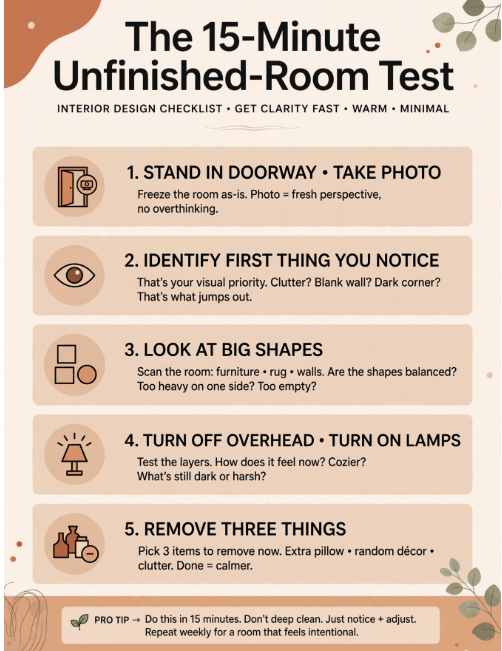
The 15-Minute Unfinished-Room Test
Before spending money, try this.
Minute 1–3: Stand in the doorway
Take a photo.
Don’t analyze the room while standing in it.
Look at the photograph instead.
Minute 4–5: Identify the first thing you notice
Is it:
- A blank wall?
- A television?
- An awkward furniture arrangement?
- A tiny rug?
- An empty middle?
- A cluttered surface?
That is your first clue.
Minute 6–8: Look only at the big shapes
Ignore candles and pillows.
Look at:
- Furniture
- Rug
- Walls
- Windows
- Lighting
Fix the largest problem first.
Minute 9–11: Turn off the overhead light
Turn on your lamps.
Does the room immediately feel better?
If yes, lighting may be one of your missing layers.
Minute 12–15: Remove three things
Take away three decorative objects.
Then look again.
If the room feels better, your problem wasn’t a lack of decor.
It may have been visual clutter.
What to Fix First
If your room feels unfinished, use this order:
1. Function
Can you comfortably use the room?
2. Layout
Does the furniture arrangement make sense?
3. Scale
Are the major pieces appropriately sized for the room?
4. Focal point
Does the eye have somewhere to land?
5. Lighting
Does the room have useful light at different levels?
6. Large vertical surfaces
Do important walls and windows feel intentionally treated?
7. Texture
Are there enough contrasting materials?
8. Color repetition
Do important colors appear in more than one place?
9. Personality
Does the room tell us anything about the person who lives there?
10. Small accessories
Only now should you worry about the final decorative details.
This order prevents you from using inexpensive accessories to hide expensive design problems.
If you want more inspiration for creating a balanced and stylish space, explore Architectural Digest’s home design ideas for practical room-planning and decorating inspiration.
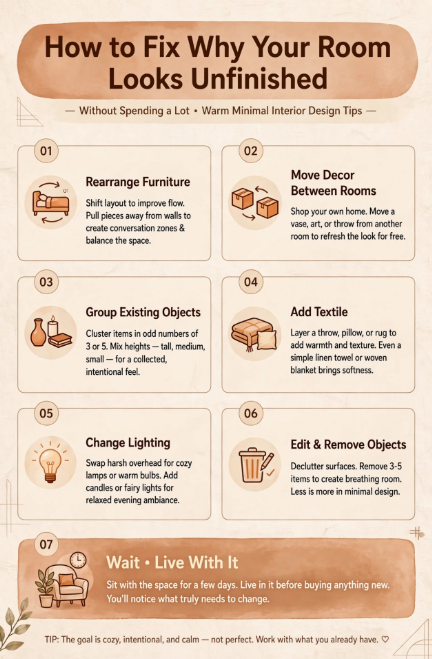
How to Fix Why Your Room Looks Unfinished Without Spending a Lot
You don’t necessarily need a shopping trip.
Try these first:
Rearrange the furniture
Changing the relationship between major pieces can have a bigger visual impact than buying accessories.
Move decor between rooms
A lamp from the bedroom might work better in the living room.
A piece of artwork might look stronger somewhere else.
Group existing objects
Instead of scattering small accessories around the room, create one or two intentional arrangements.
Add a textile
A throw, pillow cover or curtain can introduce color and texture without changing your furniture.
Change the lighting
Even one additional lamp can change the atmosphere.
Edit
Remove objects that don’t serve a functional or visual purpose.
Wait
This is underrated.
If you aren’t sure what a room needs, live with it for a week.
You’ll often discover what bothers you naturally.
What If the Room Still Looks Unfinished?
If you’ve tried all of the above and the room still feels wrong, take another photograph.
Then compare it to your favorite rooms.
Don’t copy the objects.
Compare the relationships.
Ask:
- Is my furniture too small?
- Is my rug too small?
- Are my walls too empty?
- Is everything too similar in height?
- Is the room too symmetrical?
- Is there enough contrast?
- Is there enough warmth?
- Does the room have a clear focal point?
- Is the lighting too harsh?
- Does everything look like it came from the same place?
You may discover that the issue isn’t missing decoration at all.
It may be proportion.
That’s an important distinction because accessories can’t fix furniture that is fundamentally the wrong scale.
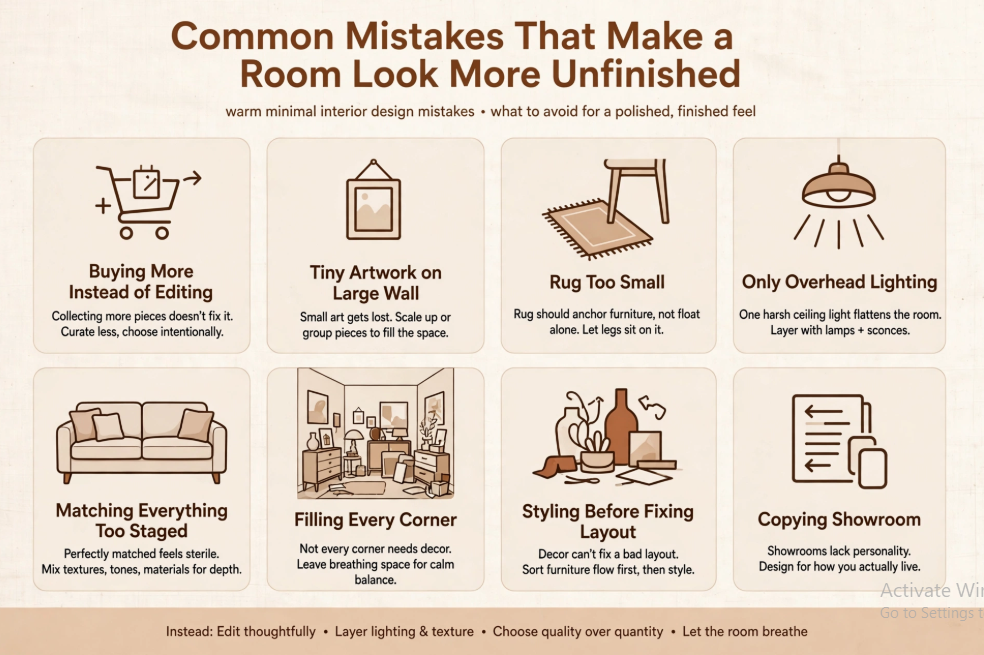
Common Mistakes That Make a Room Look More Unfinished
Buying more instead of editing
More objects don’t automatically create more cohesion.
Why Your Room Looks Unfinished: Using Lots of Tiny Artwork
Small pieces can disappear on a large wall.
Why Your Room Looks Unfinished: Choosing a Rug That’s Too Small
The furniture can appear disconnected.
Why Your Room Looks Unfinished: Using Only Overhead Lighting
The room can feel flat in the evening.
Why Your Room Looks Unfinished: Matching Everything
Perfect coordination can make a room feel staged rather than personal.
Why Your Room Looks Unfinished: Filling Every Corner
Negative space can be useful.
Styling before fixing the layout
No amount of coffee-table styling can fix a bad furniture arrangement.
Copying a showroom
A beautiful room online may not work for your lifestyle, room dimensions or daily routines.
Why Your Room Looks Unfinished: The Bottom Line
If your room looks unfished, don’t immediately go shopping.
Before running out and throwing more decor in your room, try diagnosing the room first.
Assess the:
layout
scale
focal point
rug
lighting
walls
windows
texture
color repetition
personality
Then work on the largest issue.
Sometimes it is a bigger rug or more artwork.
Sometimes it is another lamp.
Or maybe it’s curtains.
Sometimes the best choice is to remove the chair or plant or basket you put in the room just to fill that bare spot in the corner.
A completed room is not a room full of everything possible.
It is a room where the important items feel unified, useful and connected.
FAQs
Why does my room look unfinished even though I have furniture?
A room can feel unfinished when its furniture, lighting, colors, textures and decorative elements don’t form a clear visual relationship. More furniture isn’t necessarily the answer; check layout, scale, focal points and layering first.
How do I make my room look more finished?
Start with the large elements: furniture layout, rug size, focal point and lighting. Then add wall treatments, textiles, texture, repeated colors and personal accessories.
Why does my living room feel empty?
An empty-feeling living room may have disconnected furniture, a rug that’s too small, excessive space between seating pieces, insufficient lighting or too little visual weight in the center of the room.
Does every empty wall need artwork?
No. Some empty wall space provides visual breathing room. Add artwork when it improves the composition or gives an important area a focal point—not simply because the wall is blank.
How can I make a room feel finished without buying anything?
Rearrange furniture, move accessories from another room, edit unnecessary objects, group existing decor, change your lighting arrangement and adjust textiles you already own.
Why does my room look flat?
A room can look flat when most surfaces, colors, heights and materials are visually similar. Introducing contrasting textures, varied heights, lighting layers and a small amount of color contrast can create more depth.
How do I make mismatched furniture look cohesive?
Repeat a few visual elements such as color, material, shape or finish. Mismatched pieces don’t need to match exactly; they need enough shared characteristics to feel connected.
How do I make a bedroom look finished?
Start with the bed as the visual anchor. Then consider bedding layers, bedside lighting, a rug where appropriate, artwork, window treatments, and a few personal details.