






TV wall decor ideas can make a television look both practical and beautiful in your living room. The trick is to make the whole wall feel intentionally designed rather than leaving the TV floating above a small console or surrounded by random clutter.
Living room tv wall decor ideas often make the room feel more balanced while still making it easy to access and use your TV. You could add warm wood paneling to the walls, a floating console for more space, a gallery style display, or something else that makes the space uniquely yours. If you want even more storage, built in cabinets might be a good option.
You don’t need to completely renovate your room in order to make it nicer. A fresh coat of paint, some framed art, shelves, and a longer media console can all help turn a bland tv space into something more interesting without overcrowding the whole area with extra decor.
Here are 15 living room tv wall ideas to help you make the space work better for you, your decorating style, and the size and layout of your room.
Explore these 15 Living Room Decorating Ideas for Every Style to create a beautiful, comfortable space that reflects your personality and complements your TV wall decor.
15 TV Wall Decor Ideas to Transform Your Living Room
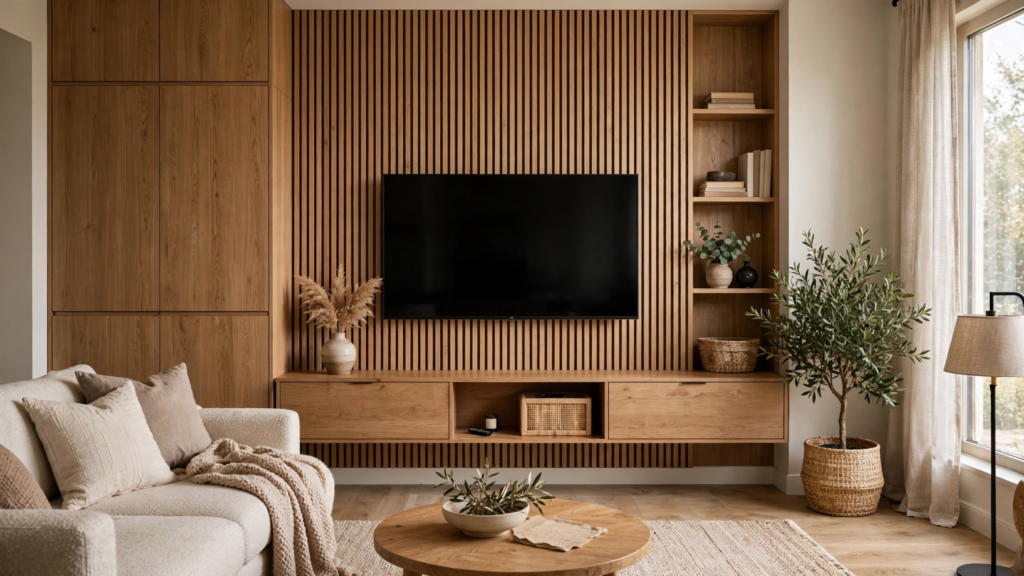
1. TV Wall Decor Ideas With Warm Wood Panels
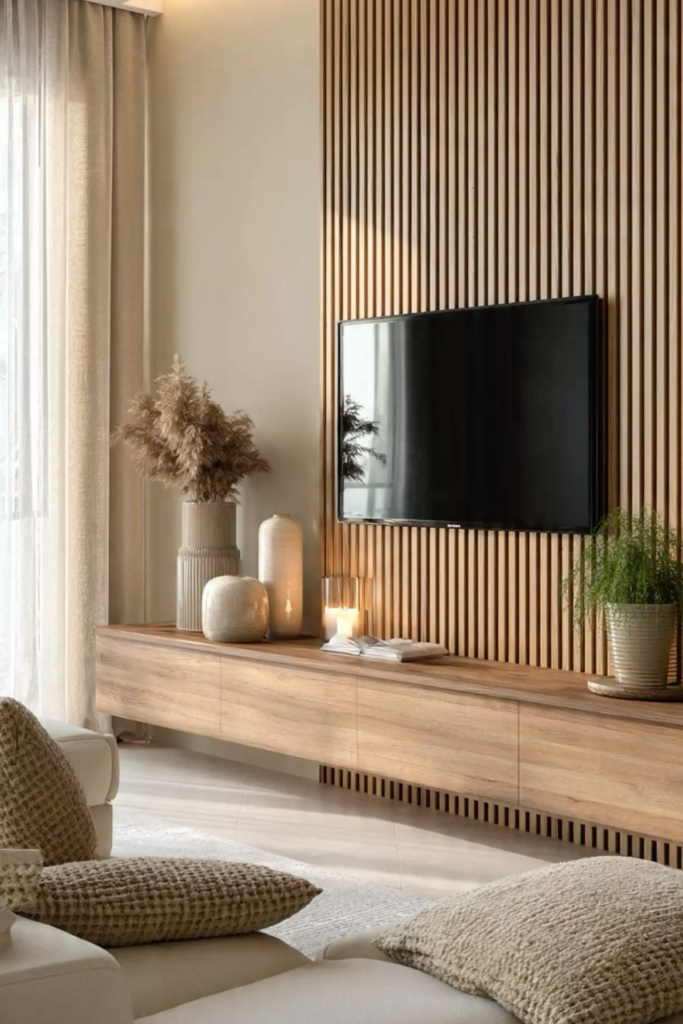
Wood paneling in the living room adds cosiness and texture to the interior while also providing a convenient background for the television. This type of decoration is especially popular in modern, Scandinavian, contemporary or Japandi style houses.
Use light oak panels to create an airy atmosphere, light wood to furnish a room in a natural way or dark walnut to make it look dramatic. The placement of the slats can also affect the mood of the space: vertical ones make the ceilings appear higher while wide planks hide minor irregularities.
How to style it:
- Extend the paneling beyond the edges of the television so it looks intentional.
- Pair the wood with a simple floating console.
- Add cream upholstery, neutral curtains, or a textured rug to soften the room.
- Keep accessories limited if the paneling already has a strong grain or pattern.
For a budget-friendly alternative, consider decorative wood-look panels instead of custom millwork. Check the mounting requirements before installing panels behind a wall-mounted TV.
Best for: Warm modern living rooms, neutral interiors, and anyone who wants a noticeable update without adding lots of small decorations.
You can also explore these 10 Christmas Home Decor Ideas for Every Style to make your home feel festive, cozy, and inviting for the holiday season.
2. TV Wall Decor Ideas With a Long Floating Media Console
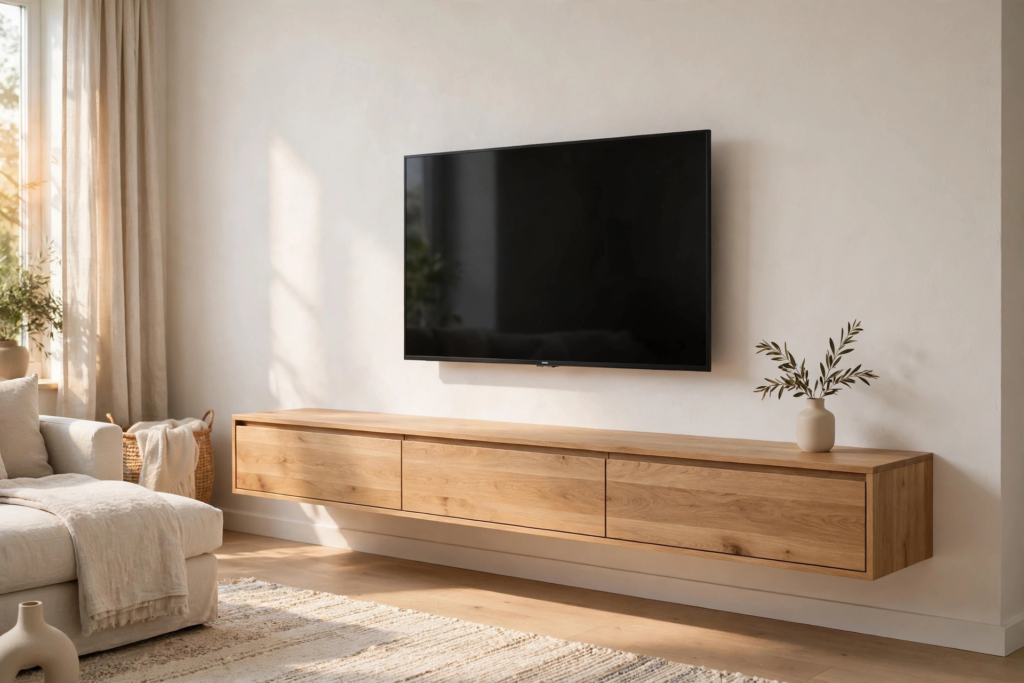
A floating media console creates a clean horizontal line beneath the television. Because it sits above the floor, more of the flooring remains visible, which can help a compact living room feel less crowded.
Choose a console that visually balances the screen. A very short cabinet beneath a wide television may look disconnected, while a longer unit can make the entire arrangement feel more cohesive.
How to style it:
- Choose natural wood for warmth or a matte finish for a minimalist look.
- Use closed drawers to store remotes, controllers, and other small items.
- Leave some of the top surface empty.
- Place a small vase or sculptural object at one end if you want a decorative touch.
If you need a soundbar or gaming equipment, check the console’s dimensions and cable openings before buying it. Also confirm that the wall and mounting hardware can support the unit safely.
Best for: Small and medium living rooms, modern interiors, and people who want a streamlined TV area with practical storage.
Refresh your bedroom with these [Bedding Set Ideas 2026: 15 Stylish Looks for Your Bedroom] to create a cozy, stylish, and inviting space for every season.
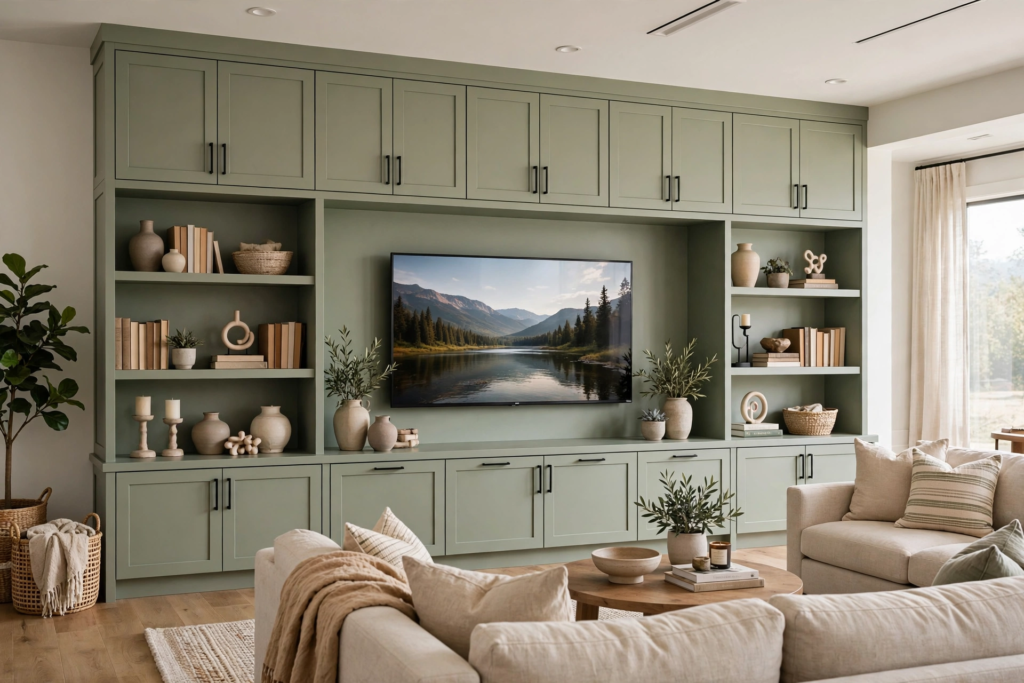
3. TV Wall Decor Ideas With Built-In Cabinets
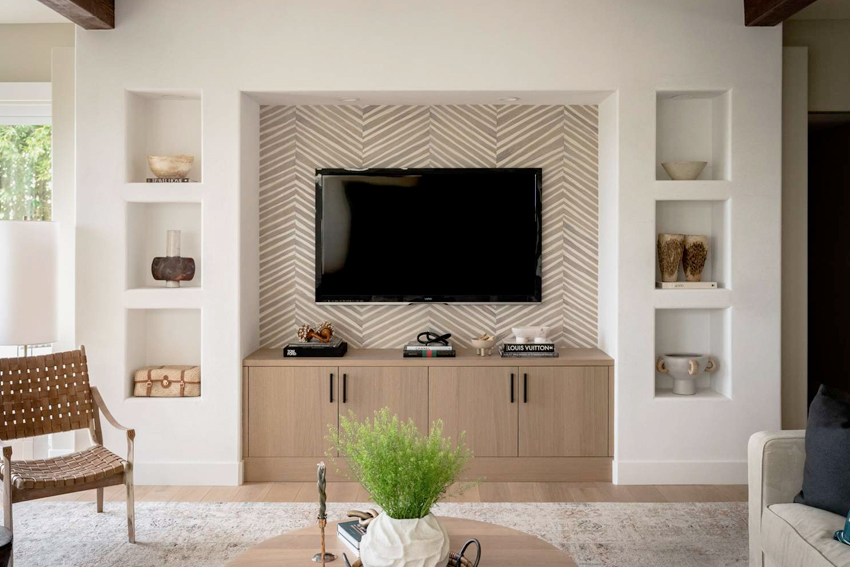
The built-in cabinetry option makes the TV part of a bigger furnishing unit. Instead of an isolated entertainment center, you can make a full picture with multiple pieces of furniture.
An example would be a central cabinet where the TV opens up in the middle. The low cabinets are framed by even higher shelves. One can see that some of the upper cabinets are closed, hiding the clutter, while the other has a couple of open shelves for displaying books and other goods.
How to style it:
- Use one main cabinet color to keep the design cohesive.
- Mix closed storage with a limited amount of open shelving.
- Leave enough clearance around the screen and electronic equipment.
- Plan power outlets, cable routes, and ventilation before construction.
Built-ins are a more permanent investment than a freestanding console, so measure carefully and consider how your storage needs may change.
Best for: Homeowners, large living rooms, family spaces, and households that need substantial storage.
4. TV Wall Decor Ideas That Turn the TV Into Part of a Gallery Wall
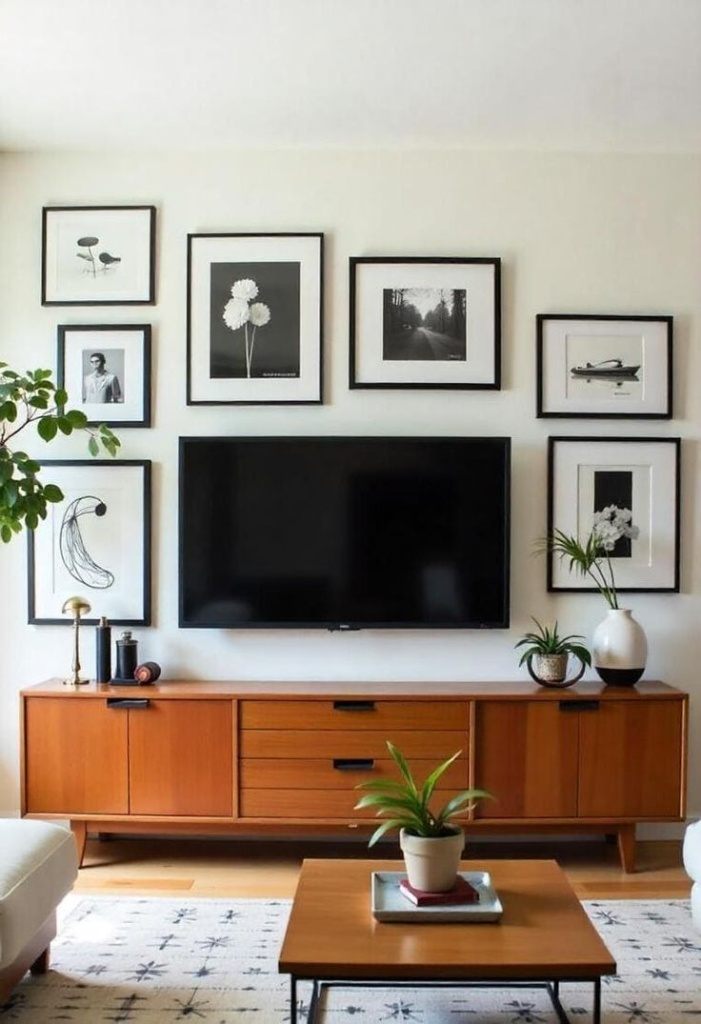
I think a gallery wall is a good idea to make your living room appear to be less tech-focused.
You could hang framed art and pictures, along with a few accessories, around the TV. The TV would then become part of the gallery display and not stand out as much as it does now.
A coordinated gallery wall displays a more put-together look than a jumbled collection of frames. It’s easier to hang things in a gallery style; you can keep it simple and hang them all so that they are the same distance apart, choose different frames with the same finish, or display them in a common color scheme or theme.
How to style it:
- Lay out the arrangement on the floor before hanging anything.
- Start with the television as the main anchor.
- Use a mix of frame sizes while keeping spacing reasonably consistent.
- Choose artwork with colors that connect to your sofa, rug, or curtains.
- Avoid highly reflective glass frames where they may catch window or lamp glare.
You do not need to cover the entire wall. A carefully arranged group of frames can provide enough visual interest without making the screen area feel crowded.
Best for: Eclectic, traditional, transitional, and collected interiors.
For more seasonal inspiration, explore our Fall Home Decor Trends 2026: Colors, Styles & Ideas to Try guide to discover trending autumn colors, cozy textures, stylish decorating ideas, and simple ways to refresh your home.
5. TV Wall Decor Ideas With a Coordinated Accent Color
Paint is one of the easiest ways to update your TV wall without breaking the bank.
Using darker shades will make your black television look less like a sore thumb, while muted tones will give it some character. Consider deeper greens, charcoals, or blues, warm taupes or neutral earthy colors that you already have in the space.
Make sure to tie it in with the rest of your space through another textile in the room, a rug, accent chair, artwork, or throw pillows
How to style it:
- Test paint samples in both daylight and evening lighting.
- Consider a matte or low-sheen finish to avoid unnecessary reflections.
- Keep the console relatively simple if the wall color is bold.
- Repeat the chosen color in small accents elsewhere in the room.
Renters should check their lease before painting. Removable wallpaper or portable decorative panels may be better options when permanent changes are not allowed.
Best for: Budget-conscious makeovers, renters with permission to paint, and anyone who wants an easy visual update.

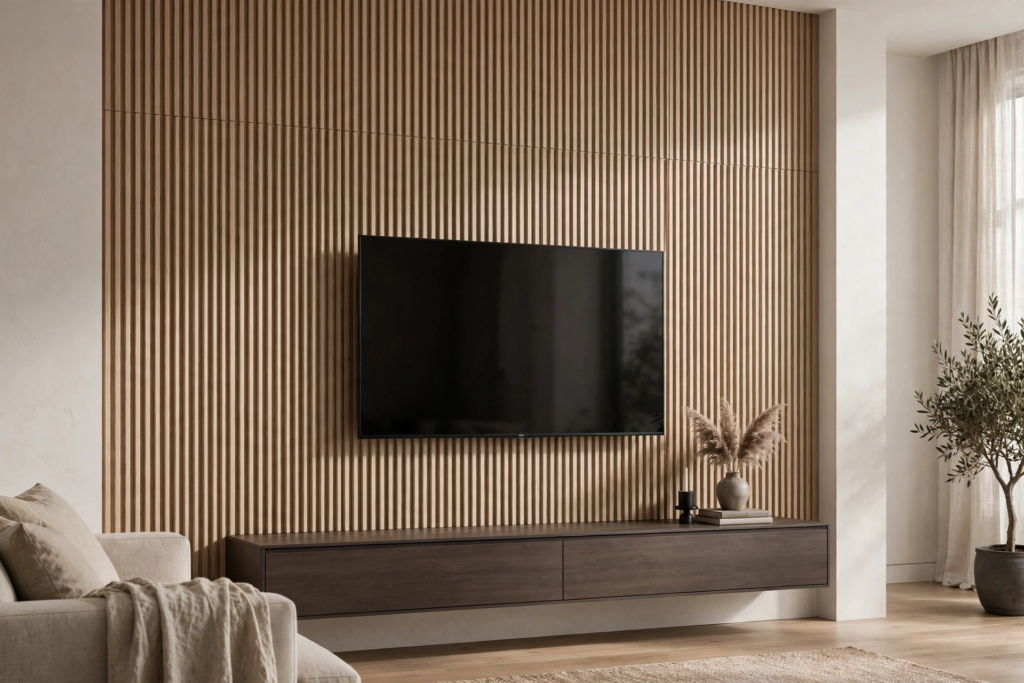
6.TV Wall Decor Ideas With Fluted or Slatted Decorative Panels
Fluted panels have repeating grooves while slatted panels have distinct narrow strips forming a linear pattern. Both add depth to a flat TV wall.
The shadows add interest without using a gallery wall of frames or cluttering the space.
To achieve a soft contemporary look consider warm beige or light oak. For a darker more dramatic effect go with walnut or charcoal.
How to style it:
- Use a panel section that relates to the TV’s width.
- Pair the textured surface with a smooth, understated console.
- Repeat the panel finish in a nearby shelf or cabinet if you want a connected design.
- Avoid combining several competing patterns directly behind the screen.
If you plan to mount the TV on top of decorative panels, ensure the mounting hardware reaches the appropriate structural support behind them. Decorative panels alone should not be assumed to carry the television’s weight.
Best for: Modern, contemporary, and minimalist living rooms.
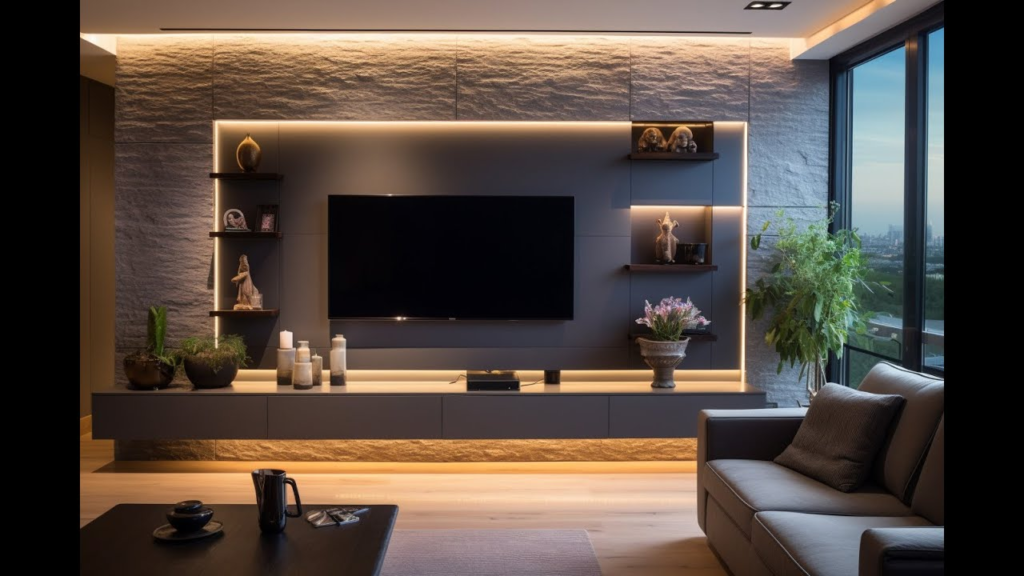
7.TV Wall Decor Ideas With a Stone-Look or Plaster Backdrop
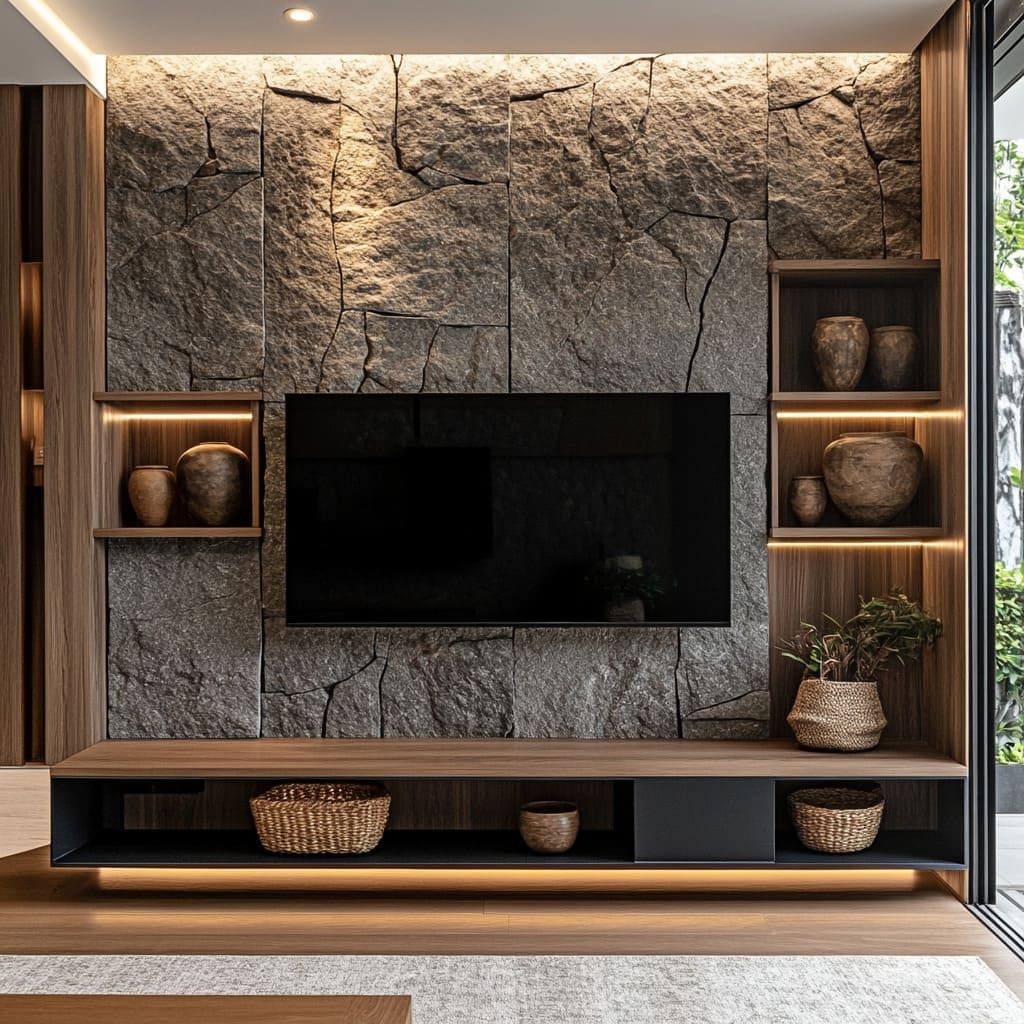
Stone-like porcelain, decorative wall panels, plaster effects and paint can make the TV wall look architectural.
This is a great solution if you want the wall to draw attention without using a lot of shelves and accents.
The warm look of the limestone will go well with the natural wood and cream upholstery, while the subtle effect of marble will match the sleek and sophisticated interior and the gentle plaster effect will harmonize with the relaxed rustic decor.
How to style it:
- Choose a finish that complements your flooring and furniture.
- Keep the console simple so the backdrop remains the main feature.
- Use wood or fabric nearby to balance harder surfaces.
- Consider lighter, lower-contrast patterns in smaller rooms.
Real stone and some panel systems can be heavy or costly to install. Decorative alternatives may provide a similar visual effect with less commitment.
Best for: Contemporary, minimalist, and luxury-inspired living rooms.
8. TV Wall Decor Ideas With Floating Shelves Around the Television
Floating shelves offer a practical way to decorate a TV wall when you want extra display space without installing a full cabinet system.
You can place one or two shelves beside the screen, add a pair of shelves on either side, or create an asymmetrical arrangement that suits the wall.
The key is to treat each shelf as a small composition rather than filling it with every accessory you own.
How to style it:
- Combine books with a ceramic vase, a small framed print, or a sculptural object.
- Vary object heights to create a relaxed arrangement.
- Leave empty space between decorative pieces.
- Use closed storage elsewhere if you have many electronic accessories.
Plants can add softness, but choose varieties and placements that work with your available light and keep water away from electronic equipment.
Best for: Small living rooms, apartment spaces, and people who want decorative flexibility.
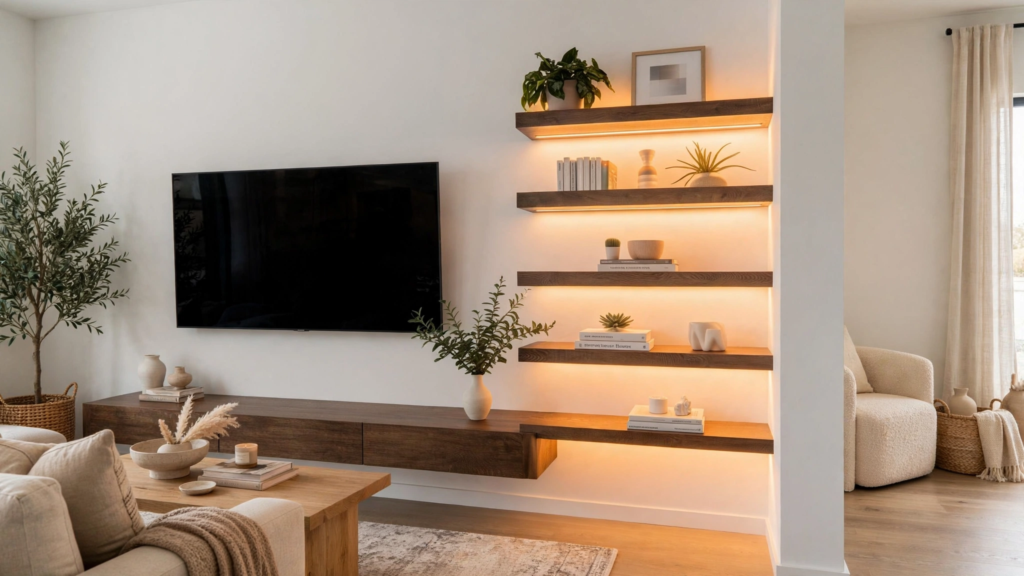
9. Create a Full-Width Media Wall
If your living room has a particularly wide or empty wall, a small panel behind the television may look undersized. Extending the design across a larger section of the wall can create a stronger sense of proportion.
A full-width media wall might combine wood paneling, a long console, closed storage, and a limited display area. It can also incorporate a reading corner or book storage when the room layout allows.
How to style it:
- Divide the wall into clear functional zones.
- Give the television enough visual space around it.
- Repeat a small number of materials throughout the design.
- Keep the color palette consistent across cabinets and panels.
- Avoid filling every section with shelves or decorative objects.
For a wall around 20 feet wide, think about the entire composition rather than just the television. A longer console, balanced cabinetry, or two distinct zones can help the design feel connected. The exact arrangement depends on the screen size, seating, doors, windows, and available storage.
Best for: Large living rooms, open-plan spaces, and wide feature walls.

10. Decorate With Wall Sconces
Wall sconces can add visual balance and a softer atmosphere around a television. Matching fixtures on either side create a symmetrical arrangement, while a single well-placed fixture can work in a more relaxed layout.
Choose finishes that connect to other elements in the room, such as black hardware, brushed brass accents, or natural materials.
How to style it:
- Match the size of the fixtures to the screen and wall.
- Use warm, comfortable lighting for evening ambiance.
- Consider dimmable fixtures when possible.
- Position the lights so they do not shine directly onto the screen.
If the wall needs new wiring, plan the electrical work before installing decorative panels or cabinetry. Plug-in sconces may be an alternative when suitable outlets are available.
Best for: Symmetrical layouts, traditional living rooms, and rooms that need additional ambient lighting.

11. Hide the TV Behind Decorative Doors or Panels
Sometimes the best way to dress around a television is to hide it when it’s off.
Cabinet doors, sliding panels, folding artwork covers, or purpose-designed concealment systems can make a living room feel less like an entertainment center.
That’s especially useful in a formal sitting room, a multi-use living-dining space, or in a home where the television isn’t used all the time.
How to style it:
- Choose a cover that complements the surrounding furniture.
- Confirm that the opening mechanism allows comfortable access.
- Account for ventilation, cables, and connected devices.
- Measure the full installation before ordering custom doors or panels.
Concealment systems generally require more planning than paint or artwork. A simple cabinet or freestanding furniture arrangement may be a more affordable solution.
Best for: People who prefer a traditional, understated, or multifunctional living room.
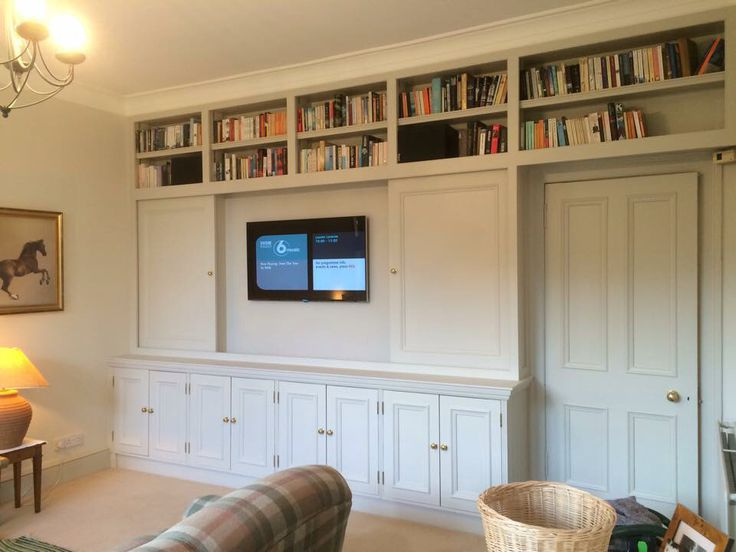
12. Make the TV Look Like Framed Artwork
A frame-style television or a compatible art-display model can make the screen appear less distracting when it is off.
Instead of trying to disguise the television, this approach would make it look more like a part of the décor.
Select frames or colors that will blend in with the rest of the furniture in the room.
How to style it:
- Select a frame finish that works with nearby furniture or picture frames.
- Give the screen enough breathing room.
- Keep other wall decor relatively restrained.
- Check the model’s display features and ongoing operating requirements before purchasing.
This option may involve a higher upfront cost than decorating an existing TV wall, so consider whether the art-display feature is worth it for your household.
Best for: Design-focused living rooms where the television remains visible even when switched off.
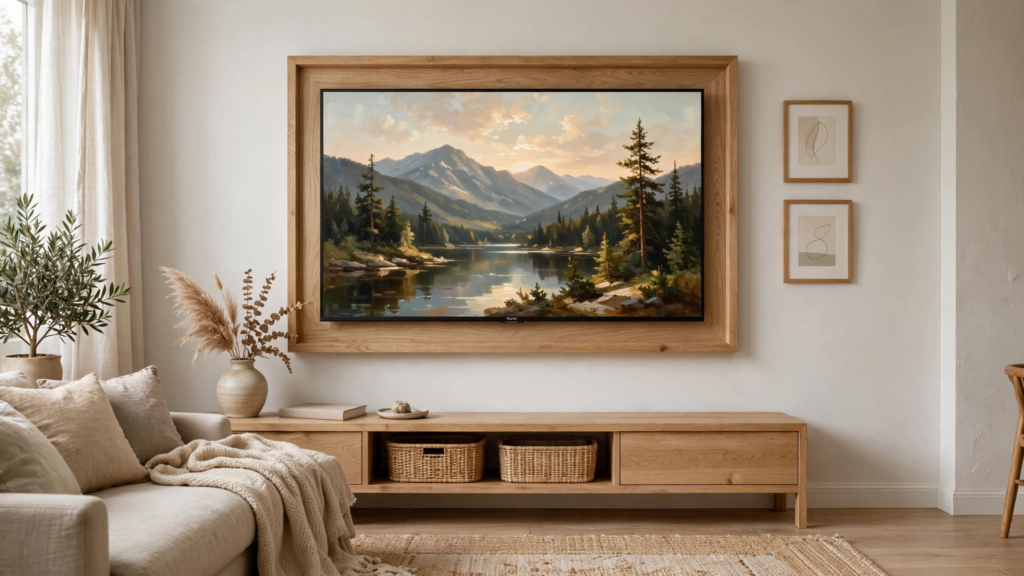
13. Create a Minimalist Black-on-Black TV Wall
A dark TV wall can make the screen feel less isolated by reducing the contrast between its black frame and the background.
You can use charcoal paint, dark cabinetry, a black panel, or a combination of these finishes. The result does not have to feel cold or overly dramatic.
Introduce warm wood, textured upholstery, or a soft rug to keep the overall room inviting.
How to style it:
- Keep the number of finishes limited.
- Use a long, simple console to ground the arrangement.
- Add warm-toned accessories for contrast.
- Test the color in your room’s natural and artificial light before committing.
A dark wall is not automatically the best option for every room. In a small space with little daylight, a lighter background may better suit your overall decorating goals.
Best for: Modern, minimalist, industrial, and contemporary interiors.
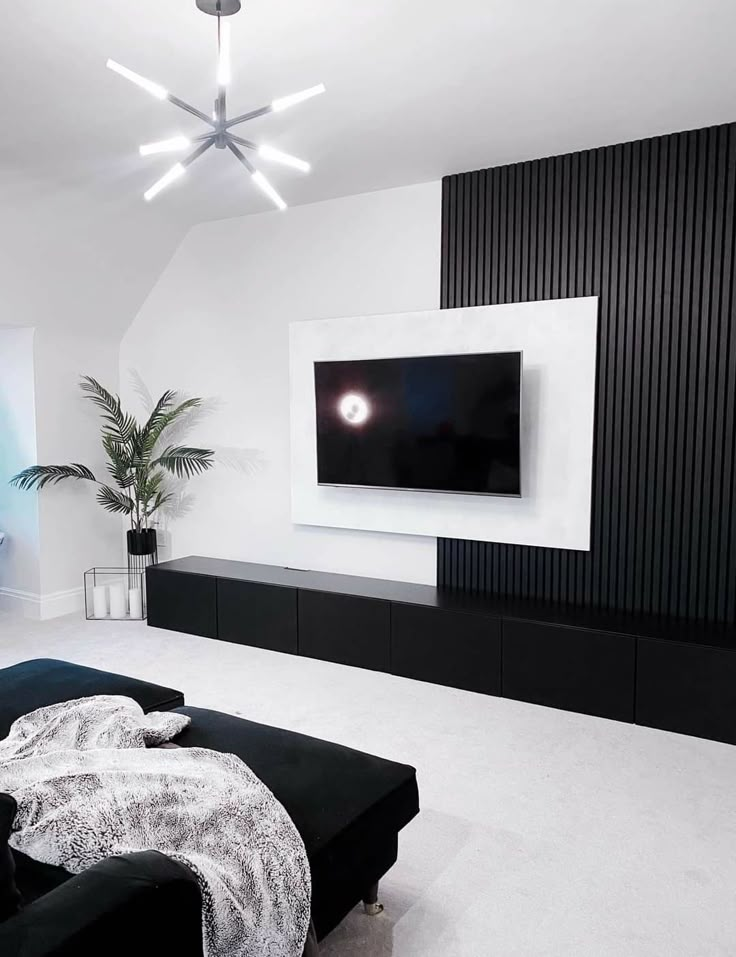
14. Try a Rental-Friendly TV Wall Makeover
You can make a rental living room look more finished without building custom cabinetry or permanently altering the walls.
Start with movable furniture and decor that you can take to your next home. A freestanding media console, framed artwork, floor lamp, and coordinated accessories can create a defined TV zone without major construction.
How to style it:
- Choose a console with enough storage for your everyday devices.
- Lean suitable artwork on furniture where it is stable and safe.
- Use removable wall coverings only after checking surface compatibility.
- Choose cable covers or management products appropriate for the wall.
- Check your lease and obtain permission before drilling or painting.
Avoid assuming that adhesive strips are safe for every wall finish. Test products according to their instructions and do not use them to support heavy items unless they are specifically rated for that purpose.
Best for: Apartment renters, students, and anyone who wants a flexible decorating solution.
15. Combine Two Complementary Treatments
You do not have to choose between a beautiful backdrop and practical storage. Combining two compatible treatments can make a TV wall both attractive and useful.
For example, wood paneling can add texture while a floating console provides storage. A painted accent wall can create contrast while a gallery arrangement adds personality. Built-in cabinets can organize devices while a few open shelves display favorite objects.
The key is to choose two treatments that work together rather than layering every idea onto one wall.
Try these combinations:
- Wood paneling + floating media console
- Painted accent wall + simple gallery arrangement
- Built-in cabinets + a few open display shelves
- Stone-look backdrop + understated wood console
- Frame-style television + minimal wall decor
- Floating shelves + closed storage below
Best for: Anyone who wants a more customized look without making the wall feel overly busy.
How to Choose the Right TV Wall Decor
If the:
Before buying materials or rearranging furniture, identify what you want the new design to accomplish.
wall feels empty: Start with paint, wood panels, textured finishes, or a gallery arrangement.
room feels cluttered: Prioritize closed storage, cable management, and a clear surface beneath the screen.
television dominates the room: Consider a coordinated dark background, a gallery wall, or a frame-style television.
living room is small: Use a slim console, limited shelving, and a restrained color palette.
wall is very wide: Extend the console or backdrop, or divide the wall into functional zones instead of using a tiny feature panel.
If you rent: Choose freestanding furniture, movable lighting, and reversible decor where permitted.
If you have a limited budget: Paint and furniture rearrangement are reasonable starting points. Add panels or custom cabinetry only if the room would benefit from a more substantial change.
TV Wall Placement and Cable Management Tips
A beautiful wall should still be comfortable and practical to use.
Position the television for comfortable viewing
Sit in your usual viewing position before deciding where the screen should go. The center of the TV should generally be near seated eye level, although the appropriate position depends on your furniture, screen size, and viewing arrangement. Samsung’s installation guidance offers approximately 42 inches from the floor to the screen center as a starting point for a typical seated setup, not a universal rule. Samsung’s TV mounting guide explains the importance of viewing height, wall support, and cable planning.
Plan cables before decorating
Decide where the power outlet, streaming devices, gaming equipment, and soundbar will sit before installing panels or cabinetry.
Paintable cable covers may work for simple surface-mounted setups. In-wall cable routing requires suitable, correctly rated components and installation that follows applicable electrical requirements. If you are unsure, consult a qualified professional.
Control glare and reflections
Check how sunlight and lamps fall across the screen throughout the day. Avoid placing reflective artwork or bright light sources where they interfere with viewing.
Check mounting safety
Use a wall mount suitable for your television and wall type, and follow the manufacturer’s instructions. Confirm that the mount is secured to appropriate structural support. For difficult wall materials or uncertain installations, professional help is the safer choice. LG’s wall-mounting guidance explains why wall type and installation conditions matter.
Be particularly careful with a television above an active fireplace. Heat and viewing height can be problems; check your specific TV manufacturer’s guidance before considering this placement.
Common TV Wall Decorating Mistakes to Avoid
- Choosing a console that looks too small: Make sure the furniture visually balances the screen and suits the available wall.
- Adding too many decorative objects: Give each shelf and accessory a purpose.
- Mixing too many finishes: One main material and one supporting finish are often enough.
- Ignoring the rest of the room: Connect the TV wall to the sofa, rug, curtains, and other furniture.
- Forgetting everyday storage: Remotes, controllers, and cables need a home.
- Mounting the TV too high for the seating arrangement: Test the position before drilling.
- Treating decorative panels as structural support: Make sure the mounting system reaches suitable support behind the finish.
- Installing lighting without checking reflections: Test the room from the sofa before finalizing fixture placement.
The most successful TV walls balance the screen with the rest of the room instead of competing with it.
Final Thoughts
The best TV wall decor ideas are the ones that make your living room feel more cohesive while supporting the way you actually use the space.
Wood paneling, floating consoles, gallery walls, accent paint, built-in storage, and concealed TV solutions can all work beautifully when they suit your room’s size and style. You do not need to combine every trend or invest in a full renovation to get a polished result.
Start by identifying your biggest problem: an empty wall, limited storage, visible cables, or a television that feels too dominant. Choose one main design feature, add only the supporting elements you need, and check viewing comfort before making permanent changes.
A thoughtful TV wall should look good when the screen is on and still feel like part of a welcoming living room when it is off.
FAQ SECTION
Choose one main feature, such as wood paneling, an accent color, a gallery wall, or a floating media console. Connect the design to your living room furniture, hide visible cables where practical, and avoid filling every empty space with decorations.
Current design coverage highlights warm wood finishes, floating consoles, integrated storage, textured panels, rounded forms, and media walls that combine furniture with architectural details. Choose a style that suits your room rather than following a trend that does not meet your needs.
Good options include wood slat panels, painted accent walls, floating consoles, built-in cabinets, gallery walls, decorative shelves, textured backdrops, and frame-style televisions. The right choice depends on your budget, storage needs, and decorating style.
Use a design with enough width to relate to the wall’s scale. Consider a long media console, a broad panel treatment, balanced cabinetry, or separate TV and display zones. Measure the wall, screen, and surrounding furniture before choosing the final arrangement.
Use a slim console, a simple painted backdrop, or a narrow panel feature. Keep open shelving limited and prioritize closed storage if the room tends to collect clutter. A few well-chosen elements are usually easier to manage than an elaborate feature wall.
A suitable surface-mounted cable cover can conceal visible wires without opening the wall. Choose a product compatible with your wall finish and the cables being routed, and follow its installation instructions. In-wall wiring may require appropriately rated components and professional installation.